

COVID-19 and following Jesus: Living sacred lives, not scared ones

By The Rev. Dr. Lauren R. Stanley, Superintending Presbyter, Rosebud Episcopal Mission (West)
I have spent almost all of Monday working on COVID-19 — preparing for its arrival in South Dakota (which I am, alas, sure will happen), working with church leaders to figure out what we will do in services, searching in vain for hand sanitizer or anti-microbial wipes, praying about how to preach this Sunday …
It’s my day off, but this outbreak of a disease that threatens the most vulnerable among us takes precedence.
And here is what I have concluded:
• COVID-19 is a serious disease. Why? Because we don’t know enough about it, and we don’t have a medicine that directly cures it. New diseases are like this — they baffle us, and because they are baffling, we become afraid.
• Too many people are dismissive of this outbreak. “We survived bird flu, Ebola, H1N1, etc., we’ll survive this.” I literally had two medical personnel tell me this just the other day. I pointed out to them that bird flu was confined, pretty much to birds; that we didn’t have Ebola in the United States (except for those who were brought back from Africa with it for treatment); and that while H1N1 was widespread, its fatality rate was 0.001 percent to 0.007 percent. Thus far, COVID-19’s fatality rate is much, much higher: an average of 3 percent to 4 percent thus far.
• The greatest risk is to those who have compromised immune systems, are elders, or a combination of both. Far too many dismissive comments are being made about them, as well. As in, “well, it’s really only dangerous to the chronically ill and older folks.” What? They aren’t important to us?! As one friend points out, that attitude pretty much condemns the sick and elders to death. Trust me, that is not what God wants. (Want to read more about this from this friend, Charis Hill, who is far more eloquent than I on this topic? Look here. And listen. Please.) Here on the Rosebud Reservation, where we still have Influenza A and B, as well as Strep, running through our schools, that means that those children are taking home their illnesses, often to grandparents, who then get sick, which means they are more susceptible to COVID-19, if and when it arrives here. None of us should be willing to condemn our loved ones to a potentially fatal disease.
Those are just the medical conclusions that I’ve reached through a lot of research from reputable sources, including the CDC.
So what does this mean to us, those who proclaim that we follow Jesus?
First, it means we have responsibilities, duties, really, that come not from medical personnel but from God.
We who follow Jesus, who say that loving God with all our heart and mind and soul and strength and that loving our neighbors as ourselves are the two most important commandments, have a responsibility, a duty, to care for each other. We don’t get to take this swiftly spreading disease lightly. We don’t get to pooh-pooh taking practical precautions. We don’t get to tell people, “It’s not big deal.”
We who follow Jesus are called by Jesus to care for each other. To wash our hands. To limit our exposure to people with suppressed immune systems. To reach out to help those in need. To check on our relatives, our neighbors, and those most in need, to ensure they have what they need.
One more time, I want to emphasize this: We really need to wash our hands!
Want to see two cool videos on this? The Doxology sung in English (here) and the Doxology sung in Lakota (here).
Good Lord, this is something we teach our children in preschool and kindergarten. Washing our hands is simply basic hygiene — only now, it has taken on even more importance. So, do it! Wash your hands thoroughly as often as you can. Sing a song whilst doing so – the Happy Birthday song, or the ABC song, twice through. Or, if you know it, sing the Doxology —in English, Lakota, or whatever language you want. (Check out these videos below.) Just don’t go too fast — that would defeat the whole purpose. If you can’t get to soap and water (a real concern in churches that don’t have running water), use some form of hand sanitizer.
When it comes to passing the Peace in church? No more hand-shaking. No matter how culturally important it is (meaning, this is incrediblyimportant among the people I serve), please, just stop. In our churches, we’ve introduced the Elbow Bump — just make sure you don’t bump too hard — elbows can be sharp! We’ve also asked people to stop hugs and kisses … just to be safe. Why not?
We don’t have any confirmed cases of COVID-19 in South Dakota yet, but already, we have asked people to be very careful intincting (dipping the bread into the wine), or to simply take a sip from the chalice. If people don’t want to sip, it really is OK to not receive the wine along with the bread. (If COVID-19 arrives in the state, then we probably will stop sharing the cup in any form. We are waiting for more guidance on this.)
But what about when we are not in church? What about when we are going about our daily lives, with all the people with whom we are in contact on a day-to-day basis?
Well, that’s where Jesus’ call to us to care for others really comes to the fore.
We all have neighbors who need help.
Help them.
Ask them if they need you to go shopping for them. Whether they need anything brought to them. Do they need some cooking done for them? Cook!
Whatever they need, we who follow Jesus are called to care for them.
This isn’t an option, by the way. Jesus never told us to help when we feel like it, or when it’s convenient. He said that loving our neighbor was one of the two most important commandments.
So we obey it.
There are other things we can do as well:
• Share our cookies. (OK, this is based not only on Jesus, but also on All I Really Need to Know I Learned in Kindergarten, by Robert Fulghum.) If you have something that another person needs, share it: Food, water, clothing, rides to the store, firewood, you name it, share it.
• Do not be afraid. That’s one of the most common things God says, usually via angels, to God’s people: Fear not! Not because God will protect us from this illness, but because we know that this life is transitory, that we have the promise that we get to spend the rest of our lives with Jesus, that there is more to life than this life. Don’t let fear paralyze us. Be brave. Go into the world and do the things that Jesus told us to do.
• Do not hoard. For some reason, not only is there a shortage of hand sanitizer (which kind of makes sense), but there is a shortage of toilet paper! People! How much toilet paper do any of us need?! Get what we need, and leave the rest for others in need. And please, we can all leave on the shelves the things that medical personnel and people with suppressed immune systems need, especially N95 face masks. Most of us will not need them; let’s make sure those who do can get them.

• Love. Need I say more?
• If you have been exposed, or think you may have been exposed, stay home. I know this is not possible for everyone – less than 50 percent of employees in the United States has paid sick leave. I’m praying that our government will do something about that. But if you can stay home, please do so. Not just for yourself, but for everybody.
We live in what are shaping up to be very scary times.
But we are not called to live scared.
Instead, we who follow Jesus are called to live sacred lives, holy lives.
And sacred, holy lives are not lived in fear, are not dominated by la-di-dahattitudes, and do not include hoarding, or “me-first” attitudes.
We follow Jesus.
Now is the time for us to step up and act like it.
• • •
An old bell will bring new joy
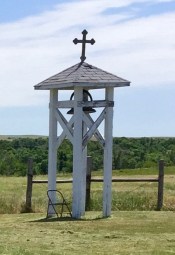
Shortly after Christmas 2017, the bell at St. Paul’s Episcopal Church just north of Norris town was stolen. The new was devastating to all of us, but especially to elders who remembered hearing that bell from the time they were little children.
We offered forgiveness to whoever took it, if they would simply bring it back to us. We put out the word on Facebook, on NPR, on Episcopal News Service, in the local newspapers, even on the radio. We had people searching high and low for our bell.
But we never found it.
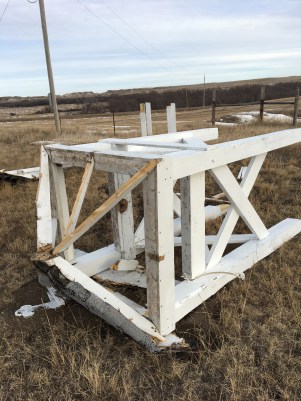

Last Friday (9.20.19), we went to Gregory, S.D., to the Episcopal Church of the Incarnation, which closed its doors on Christmas Day 2018. The small congregation made that choice, and then, under the leadership of The Rev. Annie Henninger, Superintending Presbyter of the Rosebud Episcopal Mission (East), began to distribute the furnishings to any church that wanted items.
The Rev. Dr. Lauren R. Stanley, Superintending Presbyter of the Rosebud Episcopal Mission (West), along with Senior Catechist Erroll Geboe, and volunteers Danny D. Gangone and Bruce Crow Eagle, went to claim the bell from Incarnation so that it can be transferred to Norris. There they were met by Mother Annie, and employees of the Rosebud Electric Cooperative.
Lineman for Rosebud Electric Cooperative get lots of requests to do lots of different things for the community, but it’s not often that they are asked to remove a church bell from its steeple, more than 25 feet above the ground.
But that’s what Justin Serr and Ted Stivecks found themselves doing last Friday morning at the Church of the Incarnation on Main Street.
“The bell hasn’t been rung in about 10 years,” Mother Annie said. “I’m really sad to see the church close, but it is so good to have parts from the church go elsewhere.”
Said Mother Lauren, “We are really grateful to Rosebud Electric and the guys who got this job done. I know it’s not the normal thing to ask for, but we really needed help. I asked the general manager of Cherry-Todd Electric, Tim Grablander, to get in touch with the GM of Rosebud and ask him to help us.”
Grablander told Mother Lauren that Kevin Mikkelsen, the Rosebud Electric GM, responded with an hour to her request, saying that of course the co-op would help the church.
“This is what community service is all about,” Mikkelsen said on Friday as he watched the lineman prepare to lower the bell. “We work together, so of course, we would do this.”
“I am so impressed by everyone who came out today,” Mother Lauren said. “Justin and Ted got right to work; Vic Warnke, the lineman supervisor, came to assist; Kevin Mikkelsen, the general manager, stopped by and consulted for a while; and Jason Frasch, the member services director, helped as well. It was a group effort by Rosebud Electric to support not just Gregory, but also the people of Norris, and I am so very grateful.”
After seeing the bell up close when it was loaded into her pickup truck, Mother Lauren said that instead of trying to put this massive bell at St. Paul’s, which is about five miles north of Norris town, it would go to Tiwahe ed Wacikiyapi (Family Worship), in Norris town itself. And, she said, “we’ll be building a free-standing bell tower, because this bell is a lot heavier” that the one that used to hang there. “I’m pretty certain this bell won’t even fit in Tiwahe’s tower,” she said.
The best part, she said, is that the new bell tower should be installed in time for a memorial for the elder who missed the old St. Paul’s bell the most, Emmaline Eagle Bear, who made her journey last November.
“I am determined to have some kind of bell tower in place before that memorial,” Mother Lauren said. “I want Emmaline and all the ancestors to hear this new bell ringing all the way to heaven. It won’t be same bell, or even the same bell tone (the St. Paul’s bell was cast iron and brass, while the Incarnation bell is cast steel), but it will ring all the same, and I’m confident it will bring joy to all of the ancestors.”
After receiving the bell, Mother Lauren and the others from the Rosebud (West) took it back to Mission, where it will be stored until the new tower is built. Tree of Life loaded its forklift to the church so that the bell could be unloaded.
In the coming weeks, Mother Lauren plans to ask for help from both Cherry Todd Electric Cooperative and the Rosebud Sioux Tribe for assistance in building the new tower and hanging the bell in time for Emmaline’s memorial service in November.
Below are photos from Friday’s work in Gregory and Mission.


• • •
The Good Friday Liturgy 2019: It is finished.
We held our Good Friday Liturgy and Stations of the Cross at Trinity Episcopal Church, Mission, on the Rosebud Reservation tonight. It was a holy time of hearing of the trial and crucifixion of Jesus from the Gospel of John, of praying the Solemn Collects, and of praying the Stations of the Cross with prayers written by The Rev. Margaret Watson, Superintending Presbyter of the Cheyenne River Episcopal Mission while viewing the 14 Stations painted by The Rev. John Giuliani depicting a Lakota Jesus.


The sermon preached by The Rev. Dr. Lauren R. Stanley, Superintending Presbyter, Rosebud Episcopal Mission (West), at Trinity Episcopal Church, Mission, on Good Friday.
And so we come to the night, the awful night, when everything we hoped for and dreamed about comes to an end.
Jesus has been crucified – by the Roman state, a state in the form of Pontius Pilate, who did not want a piece of this action, who did not really think Jesus was all that guilty, but who wasn’t willing to look weak in front of the Jewish leadership, upon whom he depended to help keep the peace – and at the explicit request of the Jewish leadership, which was trying to do its best to keep the Roman Empire from descending upon and destroying both Jerusalem and the Jewish people.
Jesus is dead.
And our hopes are gone.
Darkness — literal, physical, emotional, and spiritual — has descended.
And we are left to wonder:
Why?
Why did this have to happen?
Was it because we are sinners, that collectively we are a sinful people who just can’t get it right?
Or was it more than that?
Marcus Borg and John Dominic Crossan, two prominent New Testament theologians, offer a slightly different take on Jesus’ death.
“Jesus was not,” they write, “simply an unfortunate victim of a domination system’s brutality. He was also a protagonist filled with passion. His passion, his message, was about the kingdom of God. He spoke to peasants as a voice of peasant religious protest against the central economic and political institutions of his day. He attracted a following and took his movement to Jerusalem at the season of Passover. There he challenged the authorities with public acts and public debates. All of this was his passion, what he was passionate about: God and the kingdom of God, God and God’s passion for justice.
“Jesus’s passion got him killed. . . . Jesus’s passion for the kingdom of God led to what is often called his passion, namely his suffering and death. But to restrict Jesus’s passion to his suffering and death is to ignore the passion that brought him to Jerusalem. To think of Jesus’s passion as simply what happened on Good Friday is to separate his death from the passion that animated his life. …” (1)
When we speak of the Passion of Jesus, we do tend to limit it to Holy Week, to Maundy Thursday and Good Friday and Holy Saturday.
But his real passion was his entire life.
His caring for the people — especially for the people who were on the outside of society … the poor, the sick, the lame, the prostitutes and tax collectors and collaborators, the outcast of life? That was his passion.
His railing against the powers that were, against the Jewish leaders and the Roman Empire, against anyone who put their own comfort above the comfort of the people, against those who thought they knew more than God? That was his real passion.
Jesus’ passion was for the Kingdom of God that could be, that should be, that would be, if only the people would realize it.
And that is what got him killed.
Because passion threatens people.
You know it, and I know it.
Anyone who gets too passionate about a subject? They’re labeled: Radical. Too conservative. Too liberal. Socialist. Wild man. Wild woman. Irresponsible. Fickle. Dreamer.
Those are the people that to this day tend to get pounded back down into the ground.
Feed everyone? Get real. There are profits to be made!
Health care for everyone? Snort! We can’t afford it.
Justice for all? #BlackLivesMatter? #NativeLivesMatter? #LatinoLivesMatter? Hell, no! That would take power away from those in power. Forget it.
Love one another? Sure – if the “other” is someone we like, someone who looks like us, thinks like us, speaks like us, comes from the same place as us. As for the rest of them? No. Simply … no.
Welcome the stranger? What, are you kidding? Look at what those strangers have already done to us!
These were the passions of Jesus when he walked the earth.
And he was crucified for them.
Because we don’t want passionate people in charge.
We want sane people. Safe people. Even-keeled people. People who don’t threaten our very ways of life.
And yet …
These are the passions that Jesus has bequeathed to us.
Love. Love one another. As he loved us, we are to love one another.
Regardless of who that “other” might be.
It’s what Jesus wants us to do.
If we are faithful as followers of Jesus, it is what we will do.
Just be careful doing it.
Because loving one another might just mean that we, too, will be crucified for that very passion.
If you don’t believe me, look at what is happening right now in our world: Those who want to make it a better place are constantly being crucified for their ideas. Some of them even receive death threats.
Their passion for a better world has placed a target on their backs.
So yes, we are called to be passionate about loving one another.
Just know … that passion bequeathed to us by Jesus?
It might just get us killed as well.
———————-
(1) Marcus Borg and John Dominic Crossan, The Last Week: What the Gospels Really Teach About Jesus’s Final Days in Jerusalem (Society for Promoting Christian Knowledge: 2008), 161-163.
Good Friday Walk and Service 2019
We held the 13th Annual Stations of the Cross walk of prayer and witness in Mission, S.D., on the Rosebud Reservation this morning, sponsored by the Rosebud Ministerial Association. This is a one-mile walk through town, led by our local police chief, with traffic carefully flowing carefully around us.
After the walk, we break bread together at Christian Life Fellowship, then have a service with multiple preachers. This year, our theme was Holy Journey-Holy Living. The Rev. Dr. Lauren R. Stanley preached on two of the questions; her sermons are below.
Thanks go to The Rev. Jacob Boddicker, SJ, who took many of the photos during the walk. (Mother Lauren is still using her knee scooter after two surgeries on her Achilles’ tendon, so she rode in the car.)


The sermons preached by The Rev. Dr. Lauren R. Stanley, Superintending Presbyter, Rosebud Episcopal Mission (West):
Jesus announces his passion: Are you prepared to share his passion?
Matthew 20:17-19: Jesus Predicts His Death a 3rd Time
Now Jesus was going up to Jerusalem. On the way, he took the Twelve aside and said to them, “We are going up to Jerusalem, and the Son of Man will be delivered over to the chief priests and the teachers of the law. They will condemn him to death and will hand him over to the Gentiles to be mocked and flogged and crucified. On the third day he will be raised to life!”
Matthew 26:1-5: The Plot Against Jesus
When Jesus had finished saying all these things, he said to his disciples, “As you know, the Passover is two days away—and the Son of Man will be handed over to be crucified.” Then the chief priests and the elders of the people assembled in the palace of the high priest, whose name was Caiaphas, and they schemed to arrest Jesus secretly and kill him. “But not during the festival,” they said, “or there may be a riot among the people.”
(Sung)
Will you come and follow me if I but call your name?
Will you go where you don’t know and never be the same?
Will you let my love be shown?
Will you let my Name be known?
Will you let my life be grown in you and you in me?
When I was received into the Episcopal Church – on Feb. 23, 1992 – Bishop Peter James Lee of Virginia preached a sermon in which he declared:
To be a good Christian, you must be
boundlessly happy,
entirely fearless,
and always in trouble.
At the time he preached it, I was thrilled.
“Always in trouble”?
Yes!!!
Heads literally turned toward me when Bishop Lee said that, because so many of the people present thought the same thing: “Oh, that’s Lauren!”
From that moment, I began to pull at the threads of that declaration, to decipher more and more what it meant.
Will you leave your self behind if I but call your name?
Will you care for cruel and kind and never be the same?
Will you risk the hostile stare should your life attract or scare?
Will you let me answer prayer in you and you in me?
Boundlessly happy?
Are we talking Pollyanna happy, always looking at the world as though it were a happy-go-lucky place filled with lollipops, cakes and balloons, and ignoring the darkness that pervades our lives, the man-made darkness that threatens to overwhelm us on a daily basis?
Or are we talking a deeper happiness, a happiness that actually gives us life?
Over the years, as I studied to become a priest, and then served first in parishes, and then overseas on Sudan and Haiti, I came to a much deeper understanding:
We are boundlessly happy because God loves us.
And isn’t that what we all want to know in our lives, that we are loved? That someone, somewhere loves us?
Let me assure you: We are loved. From before time began until the ages of ages, God. Loves. Us.
And there’s not a darn thing we can do to escape that love.
We can try … we can ignore God … we can pretend God doesn’t exist … we can refuse God’s love.
But none of that – nothing, as Paul says, in all creation – can separate us from the love of God in Christ Jesus.
So be happy. Be boundlessly happy.
Because God loves you.
Will you let the blinded see if I but call your name?
Will you set the pris-’ner free and never be the same?
Will you kiss the leper clean, and do such as this unseen?
And admit to what I mean in you and you in me?
Entirely fearless?
This one is the hardest, because we are afraid. Most of us. Some of the time. We are afraid. There is darkness in the world. There is hunger, pain, death, and destruction. We want a better world … and we work for a better world … but far too often, it seems, the world slaps us in the face and tries to convince us that no, it’s not going to get better.
So why should we be entirely fearless when fear pervades our lives daily? Because, my friends, the worst thing that is going to happen to us — the worst thing — is that we are going to wake up and have breakfast with Jesus.
And since that is what we pray for, I have come to ask, over the years, why we would fear that?
Yes, the world will do its best to drag us down, to hurt us, even to kill us. I know this: I served in Sudan at the end of the 23-year civil war. I lived in a land where being a Christian was worth your very life, where slurs and insults were hurled daily, where guns were pointed constantly, where being disappeared was a daily threat.
But even in the face of that danger, and of every danger we counter, remember this: In the end, we get to have breakfast with Jesus.
And so … if we are willing to get to that point, despite whatever pain getting there might bring … if we remember that promised breakfast … we indeed can be fearless.
Will you love the “You” you hide if I but call your name?
Will you quell the fear inside and never be the same?
Will you use the faith you’ve found to reshape the world around
Through my sight and touch and sound in you and you in me?
And this entirely-in-trouble thing?
Well, when you consider that Jesus was the biggest troublemaker in the history of the world — that God came to be with us as one of us, and in doing so, changed that very history in such a way that 2,000 years later, we are still following him — you have to admit: He’s a pretty good example of what it means to be in trouble.
Society says exalt the rich and trample the poor?
Fight it. Jesus did.
Society says close your ranks and reject the stranger?
Fight it. Jesus did.
Society says the best way to live is I’ve-got-mine-and-I-don’t-care-if-you-never-get-yours?
Fight it. Jesus did.
Turn the world upside down and inside out? Care for the poor, feed the hungry, give water to the thirsty, sight to the blind, hearing to the deaf and voice to the mute? Make the lame leap for joy? Bring the dead back to life? Welcome the stranger – every stranger – in your midst? Throw a party for the prodigal?
Do it. Jesus did.
Jesus knew he was going to die – and that the very act of dying would be horrible.
He did it anyway.
Because he loves us.
So … just do it.
Do it — do everything — for the love of God.
Jesus did.
And he calls us to do the same.
Christ, your summons echoes true when you but call my name.
Let me turn and follow you and never be the same.
In your company I’ll go where your love and footsteps show,
Thus I’ll move and live and grow in you and you in me.
Amen.
-Will you come and follow me … Words from the Iona Community © 1989 GIA Publications
Music Mary Alexandra, John L. Hooker, © 1996
• • •
Jesus is betrayed: Who have you betrayed?
Luke 22:1-6
Now the festival of Unleavened Bread, which is called the Passover, was near. The chief priests and the scribes were looking for a way to put Jesus to death, for they were afraid of the people. Then Satan entered into Judas called Iscariot, who was one of the twelve; he went away and conferred with the chief priests and officers of the temple police about how he might betray him to them. They were greatly pleased and agreed to give him money. So he consented and began to look for an opportunity to betray him to them when no crowd was present.
John 13:21-30
After saying this, Jesus was troubled in spirit, and declared, ‘Very truly, I tell you, one of you will betray me.’ The disciples looked at one another, uncertain of whom he was speaking. One of his disciples—the one whom Jesus loved—was reclining next to him; Simon Peter therefore motioned to him to ask Jesus of whom he was speaking. So while reclining next to Jesus, he asked him, ‘Lord, who is it?’ Jesus answered, ‘It is the one to whom I give this piece of bread when I have dipped it in the dish.’ So when he had dipped the piece of bread, he gave it to Judas son of Simon Iscariot. After he received the piece of bread, Satan entered into him. Jesus said to him, ‘Do quickly what you are going to do.’ Now no one at the table knew why he said this to him. Some thought that, because Judas had the common purse, Jesus was telling him, ‘Buy what we need for the festival’; or, that he should give something to the poor. So, after receiving the piece of bread, he immediately went out. And it was night.
For the past six weeks at the Episcopal Church here on the Rosebud, we have been studying Judas’ betrayal of Jesus. Why did he do it? We asked. What drove Judas Iscariot to turn on Jesus, to reject his message of love, to betray Jesus to the leaders of the Temple?
We watched a movie called, quite simply, Judas.
It tells the story of this infamous man and shows, in the very beginning, how his father was crucified by the Romans for being a revolutionary. The movie hints that Judas’ father was a member of the Sicarii, the splinter group of Jewish Zealots strongly opposed to the Roman occupation of Judea that actively fought the Romans and all who sympathized with them. (In the movie, Judas carries a sicae, a small dagger concealed in his cloak.) (1)
So Judas, you see, was brought up with the idea that while waiting for the Messiah to come rescue the people, the people themselves needed to rise up, and to do anything – anything they could – to ride themselves of the hated Romans.
That, you see, was why Judas betrayed Jesus:
Because Jesus wasn’t the revolutionary kind of Messiah, kind of king, that Judas wanted.
The movie makes it pretty clear: Judas hated the Roman oppressors. He hated the Jewish authorities who appeased the oppressors. He hated anyone who went along with Roman rule.
He wanted a revolutionary to lead a revolution.
Jesus was a revolutionary.
And he did lead a revolution.
It just wasn’t what Judas thought it would be.
Because Jesus led a revolution of love.
And love is a hard thing to grasp.
Especially when someone out there has his boot on your neck, and tells you that you are lesser than, that you are unworthy, that you can’t rule yourself, that you can’t be trusted.
When the oppressor’s boot on your neck is choking the very life out of you, love is generally the last thing you think of.
Lashing out?
Fighting back?
Hurting the one who is hurting you?
That’s what most of us think.
It’s what Judas thought.
Which is why, I believe, Judas betrayed Jesus.
Oh, there’s the argument that needs to be voiced that if Judas hadn’t betrayed Jesus, then Jesus wouldn’t have been arrested, tortured, and murdered.
That if Judas hadn’t betrayed Jesus, then Jesus wouldn’t have died and then where would we be now?
It’s a valid argument, and one that we could explore for far more than the six weeks we set aside for this question in the Episcopal Church here on the Rosebud.
But that’s not the focus of today’s service.
Because regardless of why Judas betrayed Jesus, we still have to confront the fact that he did betray Jesus.
And today, we ask ourselves: Who have we betrayed?
Which one of our loved ones have we betrayed – by ignoring them, hurting them, speaking their secrets aloud, violating our vows of love?
Which one of God’s loved ones have we betrayed – by ignoring them, hurting them, speaking their secrets aloud, violating our vows of love to them?
We all do it.
We all betray someone in our lives.
Sometimes, we do it in anger – because we need to hurt others as they have hurt us.
Sometimes, we do it for, alas, fun – because, face it, we all become bullies at some point.
Sometimes, we do it by mistake – because sometimes, we don’t even realize what we are doing.
Betrayal, it seems, is part of our human nature.
But every single time, we must realize, the one we are really betraying is … Jesus.
When we turn our backs on strangers – we betray Jesus, because every stranger is Jesus.
When we refuse to see the very image of God in each other – we betray Jesus, because each of us is created in God’s image, and Jesus is that image.
When we lash out in anger to hurt others just because they hurt us – we betray Jesus, because he is the one who gave the new commandment: “Love one another. Just as I have loved you, you also should love one another. By this everyone will know that you are my disciples, if you have love for one another.”
There are no ifs, ands, or buts in that command. There are no suggestions. There is only the command: Love one another.
And every single time we betray someone, every single time we give in to anger, every single time we make fun of someone, or berate them, or even just slip up and say that which we should not be saying, We. Betray. Jesus.
To be honest, I do not care so much about the intimate details of our betrayals. We all do it. We are all guilty.
What I care about, especially on this day, on this Good Friday, is that we have betrayed, and the one we ultimately have betrayed is Jesus.
Who never betrayed us.
Who never betrays us.
Who will never betray us.
This love-one-another thing we are called to do is hard, I admit. I am as guilty as each of you and all of you. I react, I slip up, I say the wrong thing or don’t say the right thing, I lash out.
And each and every time, I realize – sometimes right away, sometimes not for a very long time – that not only did I betray a certain person, but that I have betrayed Jesus.
So don’t focus on the details of your own betrayals.
Focus on the big picture – the picture of Jesus. Hanging on the cross. Flesh torn. Nails in wrists and feet. Side ripped open by a spear. Thorns piercing his skull. Blood dripping.
Focus on how Jesus did not betray us, the fallen creatures whom God loved into being, whom God loves now, and whom God will always love.
Focus on how society then – and society now – betrayed Jesus.
And come Sunday, focus on that empty cross, on that empty tomb, on the knowledge that having loved us from the beginning, he loved us to the end.
And that that love is the only thing standing between us – and every betrayal we are tempted to commit from here on out.
Who have we betrayed?
We have betrayed Jesus.
At the very end of the movie, in its last 45 seconds, there is a scene that is incredible.
After Jesus has been taken off the cross, after he has been laid to rest in the Tomb, three disciples – Peter, James and John – go to the tree where Judas, having realized his great error, has hanged himself.
One of the disciples grumbles: “I don’t know why we are doing this.”
Peter’s response: “Because this is what Jesus would want us to do.”
And so they cut down Judas’ body, lay it on the ground, and then they pray for Judas. They say the prayers for the time of death, calling upon God to take this broken man into his arms.
They pray.
They love this man who hurt them all so badly – absent the Good News of the empty tomb and the Resurrected Lord.
Because Jesus told them to.
Love one another.
Even when it doesn’t make sense. Even when it hurts. Even when we don’t want to.
If we want to stop the betrayals of our lives, and of this world, we need to do the same.
Love one another. Just as I have loved you, you also should love one another. By this everyone will know that you are my disciples, if you have love for one another.”
Amen.
• • •
Maundy Thursday 2019
We held a different kind of Maundy Thursday service here on the Rosebud last night. A Facebook friend had posted her version of the service on one of the pages for women clergy, and invited us to use it.
In this service, we sat around the table, as Jesus did with his disciples. We broke bread, as he did. We shared the cup of wine, as he did. We served each other. We heard the readings and sang the hymns, and then, while we had table fellowship, we talked. About the readings. About the meaning of the Last Supper. About what it felt like to do the service in this way.
And then we washed each other’s feet. Not a deep cleaning, as we usually do. No oils or ointments to put on after. We literally just washed the dust from each other’s feet.
And then we sang some more, and said our prayers. And left St. James Chapel on the Bishop Hare Center feeling … like we had been there.


This is the service we used, adapted to our Episcopal flavor. (I wish I could figure out who posted this originally on Facebook, but I can’t find the original post anymore. If anyone knows, please let us know, so that credit can go where it is due!)
Maundy Thursday 2019
We gather together tonight, as Jesus and the disciples did so long ago, around the table. Just as they ate and talked together, so too will we. There is something amazing that happens when we fellowship and eat together: God always shows up. So, this worship will be a bit different from normal worship services, in that we will eat throughout it. For just as Christ calls us to remember Him in the breaking of the bread, and the sharing of the drink, we remember, give thanks, and praise Him tonight around the table.
The opening of our worship, and our table grace, and our communion liturgy tonight, will be hymns. We will begin by singing verses 1 and 2 of Hymn 158, Ah, holy Jesus. After verse 2, we will pause our singing, to hear the first reading, from Exodus. After that, we will pass bread to one another around the table and saying to one another, “Jesus said, ‘Remember me in the breaking of the bread.’”
Then we will sing verse 3, after which we will hearing the reading from 1 Corinthians. We then will pour a glass of wine for our neighbor and say to them, “Jesus said, ‘Whenever you drink it, do this for the remembrance of me.’” After that, we will then sing verses 4 and 5.
Opening Hymn: Ah, holy Jesus, verses 1 and 2 (Hymn 158, Hymnal 1982)
- Ah, holy Jesus, how hast thou offended,
that man to judge thee hath in hate pretended?
By foes derided, by thine own rejected,
O most afflicted.
- Who was the guilty? Who brought this upon thee?
Alas, my treason, Jesus, hath undone thee.
Twas I, Lord Jesus, I it was denied thee:
I crucified thee.
A Reading from Exodus [12:1-4, 11-14]
The Lord said to Moses and Aaron in the land of Egypt: This month shall mark for you the beginning of months; it shall be the first month of the year for you. Tell the whole congregation of Israel that on the tenth of this month they are to take a lamb for each family, a lamb for each household. If a household is too small for a whole lamb, it shall join its closest neighbor in obtaining one; the lamb shall be divided in proportion to the number of people who eat of it. This is how you shall eat it: your loins girded, your sandals on your feet, and your staff in your hand; and you shall eat it hurriedly. It is the passover of the Lord. For I will pass through the land of Egypt that night, and I will strike down every firstborn in the land of Egypt, both human beings and animals; on all the gods of Egypt I will execute judgments: I am the Lord. The blood shall be a sign for you on the houses where you live: when I see the blood, I will pass over you, and no plague shall destroy you when I strike the land of Egypt. This day shall be a day of remembrance for you. You shall celebrate it as a festival to the Lord; throughout your generations you shall observe it as a perpetual ordinance.
Take the bread and tear off a piece for your neighbor, saying,
“Jesus said, ‘Remember me in the breaking of the bread.’”
Sing verse 3 of Hymn 158.
3. Lo, the Good Shepherd for the sheep is offered;
the slave hath sinned, and the Son hath suffered;
for our atonement, while we nothing heeded,
God interceded.
A Reading from 1 Corinthians [11:23-26]
I received from the Lord what I also handed on to you, that the Lord Jesus on the night when he was betrayed took a loaf of bread, and when he had given thanks, he broke it and said, “This is my body that is for you. Do this in remembrance of me.” In the same way he took the cup also, after supper, saying, “This cup is the new covenant in my blood. Do this, as often as you drink it, in remembrance of me.” For as often as you eat this bread and drink the cup, you proclaim the Lord’s death until he comes.
Take the cup of wine and offer it to your neighbor, saying,
“Jesus said, ‘Whenever you drink it, do this for the remembrance of me.’”
Sing verses 4 and 5 of Hymn 158
- For me, kind Jesus, was thy incarnation,
thy mortal sorrow, and thy life’s oblation;
thy death of anguish and thy bitter passion,
for my salvation.
- Therefore, kind Jesus, since I cannot pay thee,
I do adore thee, and will ever pray thee,
think on thy pity and thy love unswerving,
not my deserving.
A Reading from the Gospel of John [13:1-7, 31b-35]
Now before the festival of the Passover, Jesus knew that his hour had come to depart from this world and go to the Father. Having loved his own who were in the world, he loved them to the end. The devil had already put it into the heart of Judas son of Simon Iscariot to betray him. And during supper Jesus, knowing that the Father had given all things into his hands, and that he had come from God and was going to God, got up from the table, took off his outer robe, and tied a towel around himself. Then he poured water into a basin and began to wash the disciples’ feet and to wipe them with the towel that was tied around him. He came to Simon Peter, who said to him, “Lord, are you going to wash my feet?” Jesus answered, “You do not know now what I am doing, but later you will understand.” Peter said to him, “You will never wash my feet.” Jesus answered, “Unless I wash you, you have no share with me.” Simon Peter said to him, “Lord, not my feet only but also my hands and my head!” Jesus said to him, “One who has bathed does not need to wash, except for the feet, but is entirely clean. And you are clean, though not all of you.” For he knew who was to betray him; for this reason he said, “Not all of you are clean.”
After he had washed their feet, had put on his robe, and had returned to the table, he said to them, “Do you know what I have done to you? You call me Teacher and Lord–and you are right, for that is what I am. So if I, your Lord and Teacher, have washed your feet, you also ought to wash one another’s feet. For I have set you an example, that you also should do as I have done to you. Very truly, I tell you, servants are not greater than their master, nor are messengers greater than the one who sent them. If you know these things, you are blessed if you do them.
“Now the Son of Man has been glorified, and God has been glorified in him. If God has been glorified in him, God will also glorify him in himself and will glorify him at once. Little children, I am with you only a little longer. You will look for me; and as I said to the Jews so now I say to you, `Where I am going, you cannot come.’
“I give you a new commandment, that you love one another. Just as I have loved you, you also should love one another. By this everyone will know that you are my disciples, if you have love for one another.”
Meal We share in the bread, the vegetables, the eggs, and the meat
while we reflect on the Gospel message.
Foot washing at the tables
During the foot washing, we will sing Hymn 602, Jesu, Jesu, from Hymnal 1982
(sing repeatedly until the foot washing is done)
[Chorus:]
Jesu, Jesu, fill us with your love,
show us how to serve
the neighbors we have from you.
1 Kneels at the feet of his friends,
silently washes their feet,
Master who acts as a slave to them. (Chorus)
2 Neighbors are rich and poor,
neighbors are black and white,
neighbors are nearby and far away. (Chorus)
3 These are the ones we should serve,
these are the ones we should love.
All are neighbors to us and you. (Chorus)
4 Loving puts us on our knees,
serving as though we are slaves;
this is the way we should live with you. (Chorus)
The Prayers:
As Jesus prayed the night he washed his disciples’ feet, so we now pray:
Make us one, as you are one, Father, Son and Holy Spirit.
For boldness to speak and live the truth,
for protection in the face of harm,
and for mercy to forgive all who harm us:
Make us one, as you are one, Father, Son and Holy Spirit.
For growth in holiness through your word,
commitment to compassion and justice for all people,
and love for one another as you have loved us:
Make us one, as you are one, Father, Son and Holy Spirit.
With all among whom you send us,
people who are sick, homeless, or in prison,
with leaders and those with means and influence,
and with those who reject or do not know your love:
Make us one, as you are one, Father, Son and Holy Spirit.
Closing Hymn: Were you there when they crucified my Lord? (Hymn 172, Hymnal 1982)
- Were you there when they crucified my Lord?
Were you there when they crucified my Lord?
Oh! Sometimes it causes me to tremble, tremble, tremble.
Were you there when they crucified my Lord?
- Were you there when they nailed him to the tree?
Were you there when they nailed him to the tree?
Oh! Sometimes it causes me to tremble, tremble, tremble.
Were you there when they nailed him to the tree?
- Were you there when they pierced him in the side?
Were you there when they pierced him in the side?
Oh! Sometimes it causes me to tremble, tremble, tremble.
Were you there when they pierced him in the side?
- Were you there when they laid him in the tomb?
Were you there when they laid him in the tomb?
Oh! Sometimes it causes me to tremble, tremble, tremble.
Were you there when they laid him in the tomb?
Blessing
Almighty God, we pray you graciously to behold this your family, for whom our Lord Jesus Christ was willing to be betrayed, and given into the hands of sinners, and to suffer death upon the cross; who lives and reigns for ever and ever. Amen
• • •
Children’s Festival 2018
We held our 6th Annual Children’s Festival in July, and had an absolute blast! More than 500 children and adults came to our four-hour party, and enjoyed the love of 40 co-sponsors’ food, gifts, games, giveaways, and fun, fun, fun!


Niobrara Convocation 2018 on the Rosebud
The Rosebud Episcopal Mission hosted the 147th Niobrara Convocation at the Bishop Hare Center in Mission in June 2018. Hundreds of people from throughout South Dakota, North Dakota, Minnesota and Nebraska. We built and consecrated a new Fellowship Arbor in honor of The Rev. Webster Two Hawk Sr., our senior priest in South Dakota. We held a children’s program, sang a lot of hymns, prayed mightily, and celebrated the life of Niobrara Convocation.


• • •
GLORY, GLORY! What a party!
We had our last night of GLORY for the school year. In two days, the kids will be out for summer vacation, and we wanted to send them out on a high note. We brought in 10 – TEN – large pizzas, banana splits, and watermelon, and then went outside for a glorious time of Flip the Whip!
Don’t know that game? Well, you should! It’s great fun. You put a dab of spray whipped cream on your finger tips, then smack your arm at the elbow to make the blob fly into the air, and then, of course, you try to catch it in your mouth! It was pretty windy tonight, but the kids were game to try and try again!
And then we gave the children fidget spinners and Rubik’s cubes – regular and pyramid shaped – to keep them challenged over the summer.


• • •
Easter Day on the Rosebud …
It was a magnificent Easter on the Rosebud, starting with Sunrise services at Trinity Cemetery in Mission and Holy Innocents Cemetery in Parmelee, followed by services at Church of Jesus, Rosebud; Trinity, Mission; Holy Innocents, Parmelee; Grace Chapel, Soldier Chapel; St. Paul’s, Norris, at Tiwahe ed Wacikiyapi, Norris; and St. Thomas, Corn Creek.
We baptized another 19 people, including one young boy, Kollin (pictured above), who spontaneously decided he wanted to be baptized at Trinity, Mission, and then came to Holy Innocents, Parmelee, to assist in the baptisms of his cousins; one adult; several babies; and several young children.
And then, to make it all the more holy and enjoyable, we blessed the marriage of Twila and Roger, who couldn’t have been more pleased to stand together before the altar of God.
Easter blessings!


Easter Vigil on the Rosebud …
Alleluia! Christ is risen!
The Lord is risen indeed! Alleluia!
Oh, my, we got to kick off Easter with a wonderful Great Vigil that included NINE baptisms and 86 people for a raucous celebration tonight! We welcomed into the household of God Ezra Elise’iana, Aidyn, Kylan, Tiana, Gunner Jr., Julianna, Brandon, and Eli. Welcome, little ones!


Good Friday on the Rosebud …
 Every year, the Rosebud Episcopal Mission participates in the ecumenical Stations of the Cross walk through the town of Mission. This year, there were about 40 or so people who joined together to remember the darkness of this day 2,000 years ago.
Following the 1-mile walk through town, we gathered this day at Christian Life Fellowship, where six of us took turns preaching the Seven Last Sayings of Jesus. Because we only had six preachers, I preached twice – first on Mark 15:34 – My God, my God, why have you forsaken me? – and then on Luke 23:46, Father, into your hands I commend my spirit.
I owe a deep debt of gratitude to Geraldine “Sweetie” Provencial, who at 8:30 this morning posted on Facebook about the tragic loss of her son, Justin Casey “Boo” Provencial one year ago today. These sermons would not have been the same, or had the same impact, without Sweetie’s grief and love.
One sermon in two parts (by The Rev. Dr. Lauren R. Stanley)
Good Friday 2017
Rosebud Ministerial Association
First sermon: Mark 15:34:
At three o’clock Jesus cried out with a loud voice, Eloi, Eloi, Lema sabachthani?
My God, my God, why have you forsaken me?
We all know this feeling, don’t we?
That feeling of abandonment, of enkataleipō, of having our connection with someone or something separated, of being abandoned, of having someone we love desert us ..,
We’ve felt it right here on this Rez in just the last year …
We heard that cry when little Serenity, all of 11 months old, the child who delighted the nurses and doctors at the Castle with her playfulness and joy and tenacity, lost her fight with leukemia, and we had to bury her tiny body …
We heard that cry when Justin, known to his family as Boo, died with his friend Trey in a car accident not a mile from Boo’s home, and was found by his own father …
We heard that cry when Little Cesaer, not yet 4 years old, was mistakenly run over and killed by his mother, who was going to the store to get more fireworks for her children, and did not know that her baby boy had scooted out the door and was running around the back of the car to get to his normal spot in the back seat …
We heard that cry a few weeks later, when news swept across this Rez of the terrifying accident in Corn Creek that killed Kayden and Bryer and Jenna and Katie and Jordyn, and left Hunter and little Payton critically injured …
We heard that cry when Babe … and TJ … and Kari … and Jewels … and Alvin … and Billy … and Terry … and so many others lost their lives to the dreaded disease of suicide …
We heard that cry when Lucas’ family finally found him after searching for seven days, with no answers yet as to what really happened …
Every single one of those cries has been like Jesus’ – a boaō of desperation and deep, soul-splitting anguish …
We have heard those cries, and we have issued those cries ourselves …
My God, My God, why have you forsaken me?
Jesus’ boaō – his use of Eloi instead of Abba – these are cries of desperation that enable us to catch the tiniest glimpse of what it must have cost Jesus to die for our sins,(1) to die for us.
It cost him not just the physical pain, but for at least a little while, a total separation, a total abandonment by God. And that separation, that abandonment? It teaches us something about how much the Father and Son love us – so much that they are willing to sever for a time their love for each other(2) in order to demonstrate their love for us.
Yes, we know this cry of abandonment. We know this cry of desperation. We know this feeling of desertion.
In our moments of deepest despair, we, too, hurl forth our boaō, we, too, live with the pain of separation …
I ask you to listen to the words of Sweetie Provencial, who lost her son Boo a year ago this morning, and who just a few hours ago wrote:
A year ago today was the last time I would hear my son say “By mama, mommy, mother, mom..(he sure had a way with words)… he copied that little man on a TV show that stars as a baby but is an adult – it was an annoying voice, lol! Justin always imitated different characters, even Pee Wee Herman’s laugh. He would do that while tapping my shoulder and stand right by me. God took Justin from us. Justin was a special person on this earth to so many people. He was 23 years old; he was still learning and living. I asked God why; I did fall to my knees. My son, the pain is like no other that I felt in my entire life. I can tell you one thing, (one) sure thing though, when I cried in sorrow, asking God why and where my son was, if he was in God’s hands – I’m a mother, it’s what we do for our children …. At the time, I was in the deepest sorrow. I saw my son laying there at the funeral home. It was unbearable, I was numb, [I] couldn’t even talk; the lump in my throat was like a ball of fire. I asked God again, so many why’s and where’s …
In that moment, Sweetie, like so many others, knew exactly what Jesus felt on the cross, that enkataleipō, that total separation … Like Jesus, she, like so many others, issued the same boaō …
My God, my God, why have you forsaken me?
(Silence)
• • •
Second sermon: Luke 23:46:
Then Jesus, crying with a loud voice, said, “Father, into your hands I commend my spirit.” Having said this, he breathed his last.
There is no boaō here, not in Luke’s Gospel. Instead, Jesus’ “loud voice” is megale, meaning “great” or “huge,” in the widest sense.(3) This is not a cry of despair, as we found in Mark’s Gospel – this is a deliberate act to make sure that all who had ears to hear heard this cry … a cry of determined faith.
And there is no Eloi here, no formal “My God” spoken from the distance of desertion and abandonment. No, in Luke’s Gospel, we hear Jesus use the familiar term for Father; we hear Abba, a term of love, a term of trust. Mark’s cry of desperation is replaced in Luke with the intimacy which shows that no matter how bleak the moment, death is no out-of-control enemy slaying Jesus, because Jesus knows his Father is present with him(4)
And with that knowledge, Jesus is able to paratithēmi – to entrust to someone for safekeeping, … especially to “entrust someone to the care or protection of”(5) his whole life, his flesh, his very Incarnation.
In doing so, he surrenders literally what he has prayed daily: From Psalm 31, “Into your hands I commit my spirit; redeem me, O Lord, the God of truth.”
As a devout Jew, Jesus is able to let go of the pneuma, the breath of God that inspired him at birth. He has prayed these words every day at the end of each day. Now he prays them at the end of his life – his physical life – in order to begin the rest of his life., the Life that the Father has to offer in his own presence.
Whereas in Mark we heard desperation, in Luke we hear determination. In the former, we are abandoned. In the latter, we are reassured.
In the latter, we hear the promise of life everlasting … the promise that God is not only with us in this life, but that we will be with God for the rest of our lives.
Listen again to the words of Sweetie Provencial, to the rest of her story on the day Boo died:
I asked God again, so many why’s and where’s … at that same moment, the funeral director came straight towards me and pulled me aside. She says, “Here, this was in his front left pants pocket.” I [saw] it was a crucifix with a few of the beads. For me, that was a direct answer from God: My son is with God and all who already passed on. [A]t that moment, all I felt was peace and calm. I think about that moment all the time – that is how I have been getting through this sorrow of grief. I miss my son; we feel a great emptiness. He was one of a kind; he will be in my heart forever. Not one day goes by that I don’t think of him. We will all meet up again, I know we will. Say a prayer for my son today, Justin Casey Provencial (RIP). Forever in our hearts and memories. My son….
On Good Friday … especially on that first Good Friday, the one that occurred about 3 in the afternoon, outside the gates of Jerusalem, about 2,000 years ago … we are not yet supposed to know the rest of the story. We are not supposed to know – yet – about Easter.
But we do know this:
We can entrust ourselves to God, we can paratithēmi everything we have and everything we are …
Because we are not alone. We are never alone.
Amen.
(1) Dr. Ralph F. Wilson, http://www.jesuswalk.com/7-last-words/4_forsaken.htm
(2) Ibid.
(3) http://ww.jesuswalk.com/7-last-words/7_commit.htm
(4) Ibid.
(5) Ibid.
Stations of the Cross Walk in Mission on Good Friday 2017
• • •


Good Friday Liturgy with Stations of the Cross @ Trinity, Mission


We cannot look away. Do NOT look away.
A sermon preached on John 19:1-42
by The Rev. Dr. Lauren R. Stanley at Trinity Episcopal Church, Mission
In the past few weeks – heck, in the past few days – we have, once again, seen the darkness that threatens to overcome the light that has come into the world.
We have seen innocent families with their innocent children poisoned in the middle of the night – by their own leader.
We have seen cruise missiles launched – in the middle of the night – as a show of strength.
We have seen barrel bombs dropped on innocents, and regular bombs dropped on hospitals.
We have seen men drive trucks into crowds of innocent people.
We have innocent allied troops mistakenly killed by their own innocent allies … this not once, but at least twice.
We have seen our Coptic sisters and brothers in Christ slaughtered by bombs as they worshipped in Egypt on Palm Sunday.
We have seen yet another school shooting, with an innocent teacher gunned down by her estranged husband, and an innocent child who struggled with joy to overcome a rare disease killed because he happened to be standing near the teacher, and another innocent child severely wounded because he also was standing in the wrong place at the wrong time.
We have seen the largest non-nuclear bomb ever used in combat – on Maundy Thursday.
We have seen a young British woman stabbed to death on this very day in Jerusalem by a young Palestinian man whom authorities said was mentally unstable, but whom the Israeli government has labeled a terrorist.
We have seen threats made – by all sides – that could result in war – unimaginable nuclear war.
We have been warned that because a drug that was never supposed to be in the hands of a state government is about to expire, the state of Arkansas is planning to put six men to death by the end of this month.
And today, we have seen – yet again – an innocent put to death by the state, cheered on by crowds that only a few days ago proclaimed this innocent man to be the new and long-prayed-for King, betrayed by one who was his own follower, deserted by those who claimed to be his closest friends, all because his message of love was seen as a threat to all the powers that were.
We have seen, and are told we will continue to see, darkness in the world.
Good Friday is good, we are told, because Jesus was willing to – and did – die for us.
But with all the darkness in the world, and all the darkness that threatens to come, it can be hard to believe that.
In the beginning, the Apostle John tells us that darkness could not overcome the light that came into the world in the incarnate being of Jesus, Son of God.
And yet, here we are, on the Friday called Good, nearly overwhelmed by all the darkness that surrounds us.
Yes, what came into being was life, and the life was the light of all people.
But there are days – and this is one of them – when the light seems only to flicker, and even to go out.
As columnist Michael Gerson wrote in today’s Washington Post,
Consider how the world appeared at the finish of Good Friday. It would have seem that every source of order, justice and comfort – politics, institutional religion, the community, friendship – had been discredited. It was the cynic’s finest hour. And God Himself seemed absent or unmoved, turning cynicism toward nihilism. Every ember of human hope was cold. And there was nothing to be done about it.(1)
With all this darkness in the world, it is easy – far too easy – to simply look away. To pretend the greater world does not exist, to hunker down with our tiospaye, with our oyate, and refuse to even feel anymore, to even look any more, at the world about us.
We are so close to being totally overwhelmed by the darkness of the world that we are like ostriches, sticking our heads in the sand and pretending that by doing so, no one will notice our great big butts sticking out for all the world to see.
Darkness descends.
And we want to hide away, to look away, to pretend that it isn’t so.
But on this day – on this day – we cannot look away.
For if we look away today, we will miss the ultimate sacrifice of one innocent man, the sacrifice that through death gives us life.
To be clear: Jesus’ whole life is an atoning sacrifice. The cross simply crystallizes that for us.(2) Sacrifice, as Bishop Jake Owensby writes, is not just the blood penalty required to satisfy God’s sense of justice. It is also a freely given, deliberate offering.(3) And Jesus offered his whole life – every moment of it – freely and deliberately. By preaching and teaching. By healing. By giving food to the hungry and water to the thirsty and sight to the blind and hearing to the deaf and a voice to the mute, by making the lame leap for joy and the dead rise again.
And because Jesus offered his whole life to us – and then literally his actual life – we cannot look away. We cannot put our heads in the sand. We cannot pretend the rest of the world is not out there, suffering from the darkness that threatens to overwhelm them.
We cannot say, We will look at the cross on which God’s sun hung, but we will not look at the world in which God’s children suffer.
For the suffering of Jesus – agonizing, extreme, and yet freely given – is what binds Jesus to us and us to Jesus. Jesus, whom we proclaim as Lord and Savior, did not look away from the darkness of the world in which he lived and moved and had his being.
Which means we cannot look away from the darkness of the world in which we live and move and have our being.
We. Can. Not. Look. Away.
Not today.
Not ever.
(1) Michael Gerson, What Good Friday teaches us about cynicism, Washington Post, 14 April 2017
(2) Jake Owensby, Refusing to Keep a Safe Distance, jakeowensby.com.
(3) Ibid.
• • •
Maundy Thursday on the Rosebud …
On this night, Jesus had his last meal with his disciples, and then was betrayed, arrested, and tried by the Jewish leaders who feared him so much.
But first, he washed the feet of his disciples and gave us his new commandment: Love one another. Just as I have loved you, you also should love one another.
So that’s what we did: We washed each other’s feet.


Maundy Thursday 2017, Sermon by The Rev. Dr. Lauren R. Stanley:
I give you a new commandment, that you love one another. Just as I have loved you, you also should love one another.
When I lived and served in Sudan, we knew the situation – the brand-new peace that ended a 23-year war – was deteriorating. We knew that the peace the people had prayed for and worked for and fought for was in danger of ending, that it was so fragile that the slightest little bump in the road would shatter that peace in nothing flat.
Now, I didn’t get to stay in Sudan continuously for four years. The government of the United States had labeled the government of Sudan a “state sponsor of terrorism” – which meant the two governments were enemies, and that my time was very circumscribed. I was under watch continuously by the Sudanese government, and was thrown out every three months, simply because I was a white, female, American, Christian priest – I had five strikes against me before I even set foot in that faraway land.
So, on one of my many trips to the United States, as a relatively realistic person, I knew that I needed to take care of some things before I continued my service in Sudan. And one of those things was my funeral. I was not being morbid; I was being realistic, because dying in Sudan was actually not that unlikely, given the high rates of disease (and I’ve had some doozies!), or of getting hit by a wild driver (if you think we have bad drivers here, go to Sudan, where the rules are something like this: If you are a pedestrian, you have the right of way, and drivers need to stop. If you are a driver, you have the right of way, and to heck with pedestrians – get out of the way!). Or of driving along one of the four paved roads in all of South Sudan at an incredible rate of speed and hitting a goat (bad), a donkey (worse) or a camel (really, really, really bad, often fatal to both the camel and the driver).
So I knew I neeed to plan my own funeral, the service that *I* wanted. So I did. I planned, and consulted, and read Scriptures, and looked over the prayers, and tried out various hymns, and looked for preludes and postludes, and wrote down the dismissal I wanted use (it’s in Arabic, by the way …).
Now, when you are planning a funeral, you can look right in the prayer book, and it will show you exactly which Scriptures to use, Old Testament, Psalm, New Testament and Gospel.
But you know me, heaven forfend that I should follow all the rules. I know the rubrics, the instructions, in the prayer book. And I know for a fact that I do not have to use one of those Scriptures. And I didn’t want to use any of them.
So I chose another Gospel …
I chose tonight’s Gospel:
I give you a new commandment, that you love one another. Just as I have loved you, you also should love one another.
Because that’s how I want to be remembered. I want to be remembered as someone who – at the very least – tried to love.
And not just any love.
But Jesus’ love … the kind that is right up to the point of death. Right up to the point of laying down my life for you …
That was the message I wanted conveyed, should I die in Sudan … that I had tried to love, even when loving was not a safe thing to do.
Because I am convinced, to the depths of my being, that when we come face to face with God, in that moment when we transition from this life to the rest of our lives, there will be only one question that God will ask:
Did you love?
I don’t believe that God cares one whit about anything else. I believe that God cares only that we love.
My prayer is that I will be able to reply, “Lord, I tried.”
I want to be able to say, and to explain if need be, that I tried to love, even in those moments when I did not want to love.
And I want to be able to admit, “Screwed up lots of times, Lord. Sometimes by accident, sometimes by default, sometimes, even, I am ashamed to admit, deliberately. Sometimes, I got in my own way, and sometimes my own way got in the way.”
And what do I hope to hear in return? What do I desperately hope to hear in reply?
“Well done, good and faithful servant.”
Whether I deserve it or not, that’s what I want to hear.
Jesus laid down a new commandment: Love one another. Just as I have loved you, you should also love one another.
It’s not easy, this kind of loving, because it means we have to love someone even to the point of death … of our death.
But Jesus was clear: This is a commandment. This is not a suggestion. It’s a commandment!
And this, my friends, is what I strive to do. However imperfectly, however poorly, it is my goal. Every single day.
As we begin our time of foot-washing and bread-breaking and wine-drinking, of a shared meal around the table, of betrayal and arrest and torture and condemnation and crucifixion and finally, the death of our Lord and Savior Jesus Christ, I ask you … I beg you … I implore you:
Love one another.
Even as Jesus loved us.
Right up to the point of dying for each other. Amen.
• • •
It’s almost mission team time!
Soon and very soon, we’re going to have mission teams … lots of mission teams … arriving here on the Rosebud. These groups come from all over the United States, determined to learn about the Lakota culture, to build relationships, and to help. Sometimes, the groups hold Bible camps. Sometimes, they work like crazy on our projects all over the Rosebud.
Whatever they do, they bless us with their presence, their joy, their willingness to learn and play, and their work.
For a foretaste of what they will be doing this summer, take a look at last year’s great and glorious work.
We worked on our baseball field at the Bishop Hare Center so that the Boys & Girls Club ball teams could have a safe place to play, on a good field …


Following a tragic accident that took the lives of five of our young people, and seriously injured a teen-ager and a small child, two of our teams came together to help us hold a Vigil for the Rosebud Reservation community, which was in shock. In less than 24 hours, our teams designed, built and painted cross boxes for the accident victims; made candles for the Vigil; gathered everything we needed to comfort the community; set up the Todd County High School football field; and cared for the 600 community members who showed up to grieve together. These two teams, from St. Mary’s Episcopal Church in Barnstable, Mass., and Trinity Episcopal Church in New Orleans, worked hard to comfort all of us who were so deeply grieving …


• • •
December 27, 2016
16 Things That Went Right in 2016
With 2016 rapidly coming to an end, more and more people are decrying the year for its awfulness, from the deaths of celebrities to the election to the weather to just about anything else people can disparage.
But we are Christians, and we are not called to constantly complain.
We are called to celebrate the gifts that God has given us.
So instead of closing out the year complaining constantly, how about closing out the year with some good news?
How about listing 16 things that went well, that were just right, in this year?
From the Rosebud Episcopal Mission (West), our top 16…
1. #FirewoodfortheElders. Wood. Lots of wood. 19-plus cords so far for those in need. With the help  and support from so many near and far, those who cut wood and those who contributed wood, those who hauled wood, those who split it, those who delivered it, those who donated money to support the program, those who gave axes and mauls and sledges and wood splitters, and those who learned how to use those axes and mauls and sledges and wood splitters. And let’s not forget out brand-new wood barn, thanks to All Angels Episcopal Church in Spearfish!
 2. GLORY. Glory, glory, we’ve had a great time with our youth program, God Loves Our Rosebud Youth, and we are grateful for receiving a sustaining grant from our partners at St. Michael’s and All Angels, Dallas, who know a thing or two about helping the Rosebud.
3. #StandingRock. We supported it and still support it.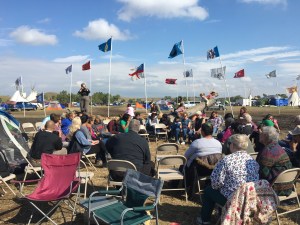 We took wood up there – almost 6 cords of it. We donated food. We donated money. We donated insulation. We publicized it and marched up there, and prayed continuously, and in a very small way, we helped stopped the Black Snake. And we remain vigilant. Always.
4. Baptisms. We did lots of them. Nearly 50 over the course of the year. From brand-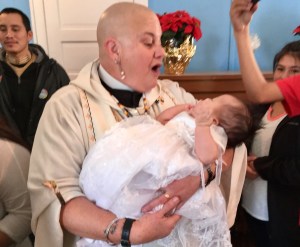 new babies to an 8-year-old who asked to be baptized to a couple of adults. We love baptisms, and do them well. We always splash a lot of water – unless the baby is sleeping, of course. Sometimes, we even bless the rest of the congregation with the baptismal waters.
5. The Discretionary Fund. We have lots of support from all over the country, and thus have been able to help hundreds and hundreds of people here on the Rosebud. Bless you, ministry and mission partners, who have been so generous and cared enough to make sure our people are always loved.
6. Mission teams. Did I mention that we have a lot of mission teams,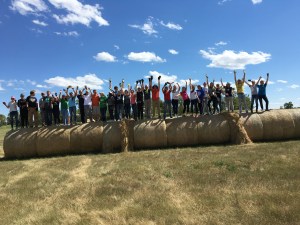 people who travel from all over the country to come here and learn about the Lakota culture, about the Rosebud, about the work we are trying to do? We had more than 40 teams join us in this ministry of restoring hope on the Rosebud, and little by little, that’s what we are doing. We love our mission partners.
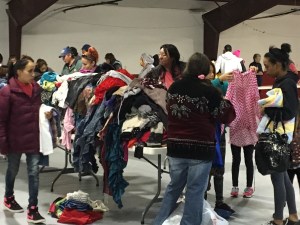 7. Giveaways. We did three major ones this year, with most of the donations coming from our mission partners at St. John’s American Lutheran Church in Sioux Falls. They collect clothing all year long, and at Christmas, they add in toys for the children. What a blessing!
8. The Children’s Festival. Oh, my good googly, do we ever have fun at the  annual event. We had to postpone until early August this year, because of a major tragedy on the Rosebud, but when it happened, it happened with style! With pizzazz! With hundreds of gifts! With 40 co-sponsors! With food! And games! And face paint! And Smother the Mother! And bubbles! And giant bouncy slides! And an inflatable water slide! And hundreds of very, very happy participants!
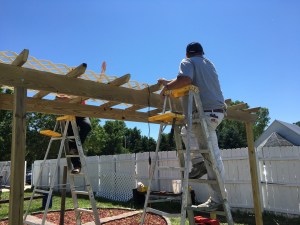 9. Community partnerships. We worked throughout the community throughout the year, helping those in need, building, painting, repairing … because for us, the whole Rosebud is our mission field. If something needs doing, we either do it, or find someone to do it, or help someone do it. We are building up our partnerships, and good things are happening as a result.
10. Church repairs. Nearly all of our churches were worked on this year,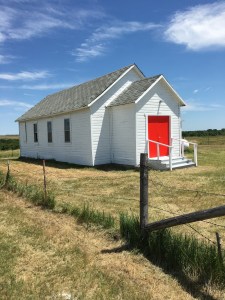 and now they look great! We scraped and painted and repaired roofs and installed new ceilings and new window panes and swept and washed and laundered … all so that the people of the Rosebud know that we care, and that we are here to stay.
11. Wakes and funerals. Yes, that sounds sad, and indeed it is. But we care for each other here. And that means doing a lot of wakes and funerals, so that we can help the deceased make their journeys and help the families with their grief. Some of our funerals have been so very tragic, but by simply being present, even when we don’t know quite what to say, we share our love. And that means a lot on the Rosebud.
13. Children’s coat drive. Our partner in Webster Groves, Mo., Emmanuel Episcopal Church, launched a winter coat drive for our elementary students, and within days of my return to the Rosebud from preaching at Emmanuel, coats started to arrive. There are more to come, and by God’s grace, we will keep our children warm this harsh winter.
14. Hats, scarves, and gloves. Children. They get hats, scarves, and gloves, 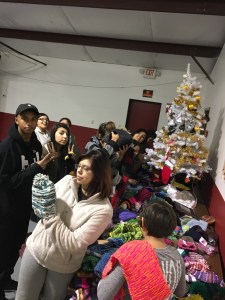 and then promptly lose them. No matter what you do, children lose their essential warmth-givers, sometimes on a daily basis. We have partners all over the country who know this, and who take care of the problem by knitting and buying hats, scarves, and gloves, and shipping them to us every winter. We then give them out, get more, then give those out, then get more … repeating as necessary. Because, children, they lose stuff, you know?
15. Spontaneous acts of kindness. Every single day, someone somewhere in this country reaches out to help, to support, to say a kind word, to keep us going here. Whether it’s reposting our Facebook posts, or sending an unsolicited donation, or praying for us (we need that – a lot!), we are supported. Which is why we use the hashtag, #WeAreBlessed, so often. Because we know we are.
16. This one is a bit premature, but … in early January, we will release our anti-suicide, anti-bullying book, SOS: Save Our Selves: Lakota Youth Talking to Lakota Youth About Suicide and Bullying. This project has been 15 months in the making. First Congregational Church in Greeley, CO, launched the initial phase of getting youths here on the Rosebud to write notes and draw pictures to end bullying and suicide. All Angels Episcopal Church in Spearfish gave us the grant to get the booklet printed. We delayed the distribution by a few weeks because it was too close to the Christmas holidays, but it goes into our schools and communities beginning next week. We hope that the youth will listen to each other, so that we can stop these terrible scourges that devour so many of our young. And we pray it will help.
So … what are the 16 things for which you want to give thanks, which you want to celebrate, as 2016 comes to an end?
Because I’m a beloved child of God, and I know it, I can’t spend all my time complaining, kvetching, or being bitter. It’s just not who I am, or who I am created to be.
You?
• • •
P.S. My sister Gabrielle gave me this coffee mug for Christmas. Pray hard is what you  normally hear. But here on the Rosebud, we don’t stop there. We Pray Big as well. That’s why we can focus on the good things that have happened here in 2016. Yes, it’s been a hard year in so many ways for so many people. But that doesn’t stop us from celebrating God’s gifts to us.
So Pray Big, people! We have a new year upon us!
• • •
March 25, 2016
Did we mention that we believe we have the best toys on the Rez? And that the first-year medical students from the Pritzker School of Medicine at the University of Chicago were here this week? And that they were cutting wood for our Firewood for the Elders program?
Well, they could have taken today off. Or easy. But noooo! Instead, they got right back to it, cutting another short cord of wood! They just … couldn’t … stop!
And then … they loaded up two cars and took off across the Rosebud, delivering wood to Grandmother Amy (remember her from last December?), her auntie, Charlotte, to Rosie Winters and her family, and to Virg Wright and her mother (oops, we forgot to take photos at the last house!). The students wanted to meet some of the people who would be staying warm … and just in time for more snow this night.


March 24, 2016
So what do you do when the first-year medical students from the Pritzker School of Medicine at the University of Chicago come to the Rosebud, and then find that there is not enough work at the hospital for them? (That’s another story for another day …)
Why, you hand them the wood-cutting tools (we like to say we have the “best toys” anywhere), train the students in their use, and set them to cutting more wood for our Firewood for the Elders program, that’s what!
On Monday and Thursday of this week, the students have really come into their own, working with community member Danny Gangone, cutting, splitting, hauling and stacking wood. And just in time: Wednesday, we were shut down by snow, and there is more on the way. On Friday, the students will help deliver wood to several elders in need …
And when they weren’t cutting wood, they were learning to lay sub-flooring in a Habitat for Humanity house that needs rehab …
Wopila to these hard-working, flexible students with a heart for service!


March 18, 2016
And we’re back!!!!!!
With thanks to our friends on mission teams from the University of South Dakota AWOL Spring Break Program and from Southwest Baptist University in Missouri, along with Wopila House member Tom Gehring and community members Danny Gangone and Rich Kills In Water, we have wood again!
In December, we lost six bins of wood when someone on this Rez forgot about the values of our community and took all the wood for themselves and their families. Rather than lashing out, or shutting down our Firewood for the Elders program, we decided to ask the community to jump in both feet first. And Wopila! The community responded!
Now, we’re back in business. Our elders and the most vulnerable among us once again can ask for wood to keep warm on these cold nights.


• • •
February 7, 2016

The sermon preached by the Rev. Dr. Lauren R. Stanley on the Rosebud Episcopal Mission (West) on the Last Sunday after the Epiphany.
In Celtic spirituality, which dates back to the early Church, there is the concept of “thin spaces,” or “thin places.” Those are the places and times when we are moved from our time, from chronos, which is governed by our watches, into God’s time, kairos, which is governed by God’s time. They are the places and times when we actually get the opportunity to see God face to face. These thin places happen all the time around us, but we have to watch for them.
I saw those thin places yesterday at Dorothy Lunderman’s funeral. The first time was watching Hubert or Sandra Dillon hold their brand new – and first – great-grandchild, a tiny little boy … Whenever either one had him in their arms, you could see their whole bodies change and their faces light up with such a special look of love that you knew God was present in a whole new way. That was a thin place …
And then again, at communion, when a grandmother was brought up in her wheelchair. I gave her the bread, and then Don Eagle bent over, and in such a tender move, gently gave her the wine, placing the purificator gently under the edge of the cup. That was a thin place that almost brought me to tears.
Thin places allow us to leave behind our everyday life and enter into a whole new dimension, one ruled by God and God’s love.
This morning’s Gospel – the story of Jesus and his disciples going up the mountain, and Jesus being transfigured, with the two great prophets, Moses and Elijah, appearing to discuss with Jesus his impending death – that’s a thin place. That’s the moment when the disciples were moved from their own time and into God’s time, and thus were able to see that Jesus truly is the Messiah, the Chosen One of God.
I know it seems that we have rushed through the season of Epiphany, and indeed we have. This is the shortest amount of time we can have for Epiphany, all because we have a very early Easter.
So we really haven’t had enough time to figure out the purpose of Epiphany, to see all the times when Jesus reveals himself. We didn’t get to hear about Peter declaring Jesus as the Messiah, and we missed other stories in Luke that would have really made it clear to us who Jesus truly is.
But if we look at the thin places, especially the thin place that is shown to us on the mountaintop, then we can see God face to face.
Trust me, we need to see those thin places because without them, we don’t know what we are supposed to do, we don’t know who we are, or whose we are, or who we are called to be.
• • •
There is one other place where I have seen such a thin place this week, and it has been over the last two days at the Ray Gassman wakes. Ray is the young man who died in the police shooting earlier this week – an officer showed up to arrest Ray, a scuffle of some kind broke out, and soon Ray was shot dead and the officer was shot and wounded.
In the immediate days after the shooting, you all know what the talk was like here on the Rez: Death threats against the officer involved, death threats against every cop, terrible accusations against every cop on this Rez, talk of wreaking havoc, talk of revenge. It was so scary that I actually went to talk with the Tribal Vice President, Scott Herman, and together we met with Police Chief Marlan Enno and a special investigator. I was desperately afraid that the wakes and funeral for Ray would turn into a disaster, a shoot-out of some kind, or violence of some other kind.
Now, let me clear: I am not talking about the rights and wrongs of this awful tragedy. I know the police officer and his family. I know that he is upset, that he never intended for this to happen. I know Ray’s family. I know they never thought this would happen. And I know the people of this Rez. I know how they feel that everything always goes against them, that a fair shake is not part of their lives.
What I am talking about right now is how Ray’s family is taking this awful tragedy and turning it into an opportunity to bring peace and hope to this Rez.
On Friday, Ray’s older brother, Bobby Gassman Jr., went to talk to the Chief of Police, to tell the police that the family was sorry for all the awful things being said, and that the family wanted peace, not war. The family took the crime scene tape that the police had put up at the house where Ray died, and tied that tape to their cars as a symbol of unity with the police. The Gassman family does not want war. They do not want to fight with the police. They want to stand together with the police.
Make no mistake: Ray’s family wants justice. They want answers. They want to know why their son is dead. They want to make sure this doesn’t happen again.
But …
They also want to make sure that we don’t erupt into violence, into a war on the police. They don’t want Ray’s death to be remembered in anger and hatred.
They want us – all of us – to join together to bring something good out of something awful.
And standing there Friday night when they brought Ray’s body to the Veterans Center for the one-night private family vigil, and again last night at the first wake, seeing all the cars with the crime-scene tape tied on them, and the children with the crime-scene tape wrapped around their wrists, I realized I once again was seeing a thin place, where God entered into our very real and hurting world and we could see God face to face.
In addition to all the goodness coming from the family, the police are trying to do the same thing. When the family brought Ray from the Veterans Center over to St. Bridget’s Catholic Church for the public wakes, the police escorted them. The police are providing the crime-scene tape – as much as the family wants.
Yes, we are angry, and that is OK. A young man is dead and a police officer is injured. It all happened in a split second, that moment when training – no matter how good it is – sometimes gives way to instinct.
Yes, Ray, who was the young man who robbed the PaulMart four years ago, who served his time in federal prison, and who walked away from the halfway house just a few weeks before his time was up, struggled with the police officer at the time of his arrest.
Yes, the police officer who was involved in this shooting death, who was injured himself, is upset. This is not what he expected or wanted to happen.
But instead of this tragedy becoming yet another dividing point on our so-very-troubled Rez, instead of fights breaking out and people being hurt, we have the chance to stretch this thin place out from a small one to a big one, so that all of the people here can experience it. We have the chance to help the people here see God face to face.
• • •
The Gospel reading this morning included the option, which I took, to read about the day after that mountaintop experience. That’s when Jesus and his disciples came down from the mountaintop and encountered the large crowd, and the father whose son had a demon and who wanted Jesus to heal the boy. Jesus casts out the demon and heals the boy …
… which is a direct message to us that for all the mountaintop experiences we desire, for all the thin places we glimpse, we still have to come down off that mountain, we still have to engage the very real world in which we live and move and have our being. We still have to come back into our world, to our people, and to help them find the thin places as well.
We have the chance, right here, right now, to do just that. We all can put crime-scene tape on our cars, on our wrists, on our waists. We can say that we are against any more violence. We can help improve relations between our police and our people. We can show the Rez that there is a better way to live, that we can live in peace, that we can get justice, that we can provide hope.
Thin places are meant to help us figure out who we are, and who God wants us to be.
What do we want to do?
Who do we want to be?
Amen.
• • •
January 19, 2016
From Tom Gehring, Young Adult Intentional Community
Lessons from the Rosebud … Bonhoeffer Among the Natives
“We have been silent witnesses of evil deeds. We have become cunning and learned the arts of obfuscation and equivocal speech. Experience has rendered us suspicious of human beings, and often we have failed to speak to them a true and open word. Unbearable conflicts have worn us down or even made us cynical. Are we still of any use?”
The above quote comes from one of a multitude of letters and papers that theologian Dietrich Bonhoeffer wrote while he was an inmate in Tegel Prison during the final days of World War II. For those reading this who don’t know me all too well, I am a bit of a Bonhoeffer fanatic. I was first introduced to his works and theology my junior year of College during a seminar on contemporary theology with a focus on theo-ethics, and his works have been shaping how I act and think ever since.
Born in Germany, Bonhoeffer grew up during World War I and began his theological studies around the start of World War II. Throughout his life, Bonhoeffer wrestled with questions of what it means to be a Christian. He is certainly not the first theologian to struggle with the Christian identity, but Bonhoeffer’s context made the experience that much more visceral for him. Bonhoeffer grew up and came to age as Adolf Hitler was rising to political power. A product of the wealthy bourgeoisie, Bonhoeffer had friends and
acquaintances extremely high up in the political world. Because he was “in the know” through his friends, Bonhoeffer saw past all of the propaganda and lies being churned out by the Third Reich and was completely aware of the evils taking place in his country. Eventually, Bonhoeffer would be arrested, imprisoned, and executed due to his involvement in a plot to assassinate Hitler. However, his time in prison produced some of the most gripping and raw theology that still holds up in this day and age.
I studied Bonhoeffer rather intensely for two years straight and during that time realized that the questions he asked and the issues he struggled with are the same questions and issues that bounce around my head at any given time of day, although they do most of their bouncing when I’m trying to fall asleep and my brain decides that it needs to figure out all of the world’s issues right then and there. The passage that I quoted at the beginning of this post is one that I continually come back to over and over again. I often find myself repeating his question over and over to myself, “are we still of any use?” In this world, in this current time, in this age of pluralism and post-enlightenment thinking, is there still a use or need for the Christian church?
It was exactly a year ago that I was studying abroad for a month in Germany researching Bonhoeffer and the Confessing Church movement that he helped spearhead. As I learned more about Bonhoeffer through my research, I found myself feeling the same way he did when he was writing his theology so many years ago: disheartened at the way the world is and wanting nothing more than to take what is broken in this world and make it right.
This new restlessness with the way the world is gave me the conviction I needed to apply for my ministry internship on the Rosebud Reservation. I did not pretend to assume that my presence alone would even begin to fix all of the problems that are experienced on the reservations, but I felt called to listen to the needs of the people here and then lend whatever assistance I am able to. In my five months out here so far, I have found that God has a habit of calling me to the ordinary places, and it is there where I most often encounter God’s tendency to accomplish extraordinary things through us.
In my time on the Rosebud, I have done a lot of projects. I helped put up new signs on the church property I live on, helped paint the interior and exterior of my house, helped care for various people’s dogs, helped purchase and deliver food for families who are running out. I have cut a lot of firewood and delivered that wood to families who need stay warm (most recently to a grandma who was burning clothing and furniture to try and keep her family warm in the sub-zero temperatures). Occasionally I carry the suicide and crisis hotline phones operated out of St. Francis here on the Rosebud. I play with our church kids every Wednesday night for our youth program, and I help lead worship around the reservation every single Sunday.
By no means am I inciting widespread reform or making life immensely better for every single person I meet. But by helping out in ways that I am able, I encounter God daily through the seemingly ordinary events of life.
My favorite example of this happened just a few short weeks ago. Over the summer, several mission groups traveled to the Rosebud in order to do service projects. A majority of these groups helped cut firewood to later be delivered in the winter. Thanks to these groups, we had a massive amount of firewood in storage ready to be delivered once winter came. And winter did come, bringing cold temperatures and biting wind. The firewood that the mission groups cut was being put to good use as Mother Lauren and I made delivery after delivery. Then Christmas came, Lauren and all of my housemates left to vacation with friends and family, and when we all returned, we discovered that all of our firewood had been taken. All of it. Enough firewood for 200 emergency deliveries was taken. We were completely out. However, instead of following our gut instinct and lashing out in anger at those who took our wood, we chose to use the situation as an opportunity for ministry and outreach. We invited community members to come help cut firewood for a couple hours at a time. The response was nothing short of phenomenal.
In just one short week of cutting firewood, we have replenished our supply enough to make at least 15 emergency deliveries. Thanks to the hard work of a group of nursing students from the University of Sioux Falls and several community members, some as young as 11 and some old enough to be called middle-aged, we are able to continue helping people stay warm. This may seem like an ordinary task; firewood doesn’t exactly look particularly flashy if you post about it on Twitter or Facebook. But, to the family shivering in their home, and to the grandma who is burning furniture, the hard work of a few can make a massive and tangible impact on the lives of those around them.
In a way, I think that this is how God calls us to change the world. If we know anything for certain, we know that suffering is a fact of life. We all have had things go wrong, life turn sour, circumstances work out for the worse. But if we, in the midst of the pain and strife that happens every single day, are able to proclaim with our lives and actions a reality where suffering does not have the final word, then I think we are living our lives in accordance to how we have been called by Christ.
The quote I put up at the beginning of this post does not end with the existential question “are we still of any use.” Bonhoeffer goes on to say:
“We will not need geniuses, cynics, people who have contempt for others, or cunning tacticians, but simple, uncomplicated, and honest human beings. Will our inner strength to resist what has been forced on us have remained strong enough, and our honesty with ourselves blunt enough, to find our way back to simplicity and honesty?”
In the short months that I have lived on the Rosebud Reservation, I have been blessed to live among and work with simple, uncomplicated, and honest human beings. As God works through us in the seemingly ordinary moments, we end up accomplishing the extraordinary.
Amen, let it be true.
• • •
January 17, 2016
When we discovered that all our wood for our Firewood for the Elders program had been taken, we were all upset. But then we decided to use this as an opportunity to get the community more involved in caring for those most in need on the Rosebud.
And the response has been fantastic.
The visiting nurses from the University of Sioux Falls joined with community members cut more wood, and we’ve been giving out that wood to elders and those in need.
This response couldn’t have come at a better time, because it is so cold here on the Rosebud (Western side) this morning that we canceled all but one service in order to keep our people home, safe and as warm as possible. We are a rural community, and with the wind chill, it reached nearly 30 below zero (and we have a lot of wind chill out here).
In addition, we give a special shout-out to the nursing students for helping us keep the Bishop Hare Road open. We need that open so that the members of the Young Adult Intentional Community at Wopila House can get out, so that the community can reach the wood we need, so that Habitat for Humanity, housed in Barbour Hall, can reach the offices, and so that the Rosebud Episcopal Mission office can stay open as well. The nursing students, along with Tom Gehring and Miranda Marks from Wopila House, spent days pounding the metal fence posts into the frozen earth, and then putting up the snow fencing in the hopes that it will keep the drifts to a manageable size on Bishop Hare Road.
God’s grace abounds here on the Rosebud. What seemed like a disaster two weeks ago has turned into an incredible blessing!


And then, just because Miranda, Tom, Jodi and Cory wanted to have some fun, they did a little “snow cannon-balling …”
• • •
January 14, 2016
We put out the call for help cutting wood for the Firewood for the Elders program, and by God’s grace, we are getting it!
Every day this week, the University of Sioux Falls nursing students who are working at IHS send two or three students to the wood-cutting area, where they labor mightily to cut wood for our elders and children. Community member Rich Kills In Water joined with Tom Gehring to teach the nurses how to cut, chop and split the wood.
And then, they all pounded in the last of the fence posts for our new snow fence along the Bishop Hare Road. When they had pounded in the last post, they took some time for real fun: Building “Fred,” the snowman!
Meanwhile, Deanne King and grandson Mauricio Roubideaux, who is 11 years old, came out in the evening hours to cut even more wood!
Firewood for the Elders WILL continue! Anyone interested in helping cut more wood should call Mother Lauren at 605-828-3892. Every community member who works for 3-4 hours doing so will receive gas money and 50 pieces of wood to take home.


• • •
January 12, 2016
Firewood for the Elders continued …
All summer long, we cut wood here on the Rosebud for our elders and families with children in need during the long, cold winter that happens here in South Dakota.
We thought we had cut enough, but over the Christmas holidays, all of our wood was taken.
So today, we began cutting wood again. One community member (Ben Kills In Water) and three volunteers from the University of Sioux Falls nursing program who are working here on the Rosebud (Megan Lozano, Bethany Danielson and Katlyn Peterson) worked with Tom Gehring and Miranda Marks, members of the Young Adult Intentional Community, and Mother Lauren to get the Firewood program going again. (Megan, Miranda and Mother Lauren also pounded in fence posts for a snow fence along Bishop Hare Road, tough work in the deep snow ..)
We are inviting community members from across the Rosebud to join us as we help to care for all those in need with emergency firewood. In return for cutting, splitting and stacking wood for 3-4 hours, we give each volunteer the first 50 pieces of wood he or she cuts, as well as help with gas costs to come to the Bishop Hare Center. We even have children as young as 6 coming to help us (they can run the splitter, which is completely safe, or help stack wood), so if you can help, call Mother Lauren at 605-828-3892.
A few pictures from today’s adventures …
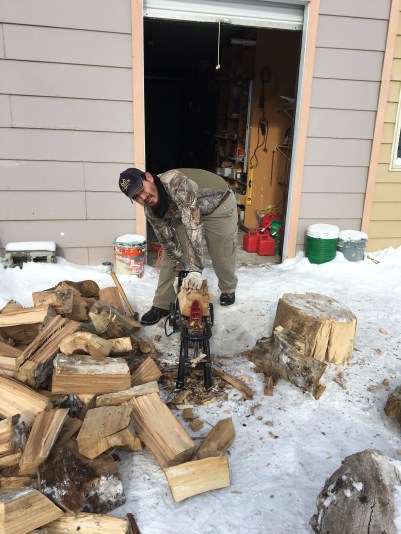


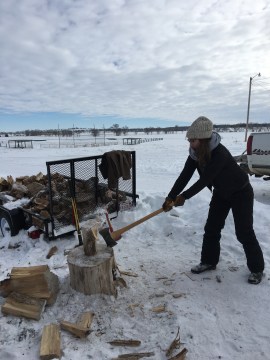
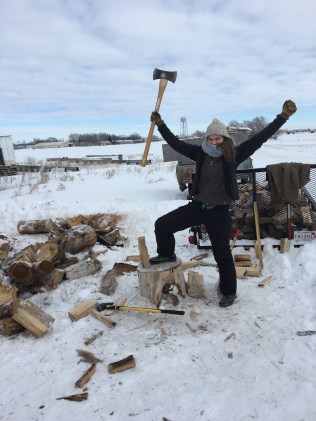
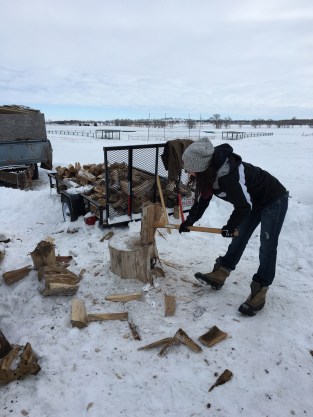
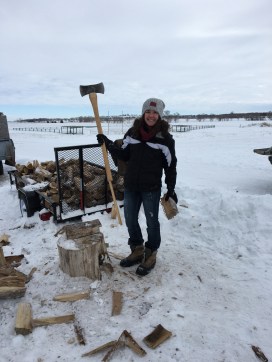


• • •
January 9, 2016
From Tom Gehring, Young Adult Intentional Community
Lessons from the Rosebud … A Ministry of Presence
 Every Sunday, I try to challenge myself to get out of my comfort zone
and sit with somebody I don’t know very well during Trinity Church’s fellowship hour following worship. Most of the time, we forego a formal introduction. We simply meet each other at the common ground of being two people sharing a space, sharing coffee, sharing conversation, and breaking bread together. The conversations I have had run the gamut from what NFL team is projected to win that week to sharing our life stories with each other. What I love is that these conversations always flow naturally and never feel forced. Last month, in the wake of a rather large blizzard that shut the school system down for three consecutive days, we shared stories from the winters of our youth. What struck me after those conversations was the farewell I received from my conversation partner: “Thanks for your company.” Essentially, he was thanking me for taking time and simply being with him. For showing up. Naturally, as is so often my habit, I started thinking at length about the theological meaning of what he had said.
The more I reflect on life and what it means to be a human (and coincidentally a child of God) in this day and age, the more my thoughts dwell upon the importance of physical presence. Let’s face it, the overwhelming majority of us live in a reality dominated by social media. Celebrity’s tweets and status updates make national headlines, we spend hours poring over our Facebook newsfeeds, we take great care in getting the “perfect” selfie (most people take an average of 7 shots before they’re satisfied), and we get our news from whatever happens to be trending on Twitter.
Social media is just one of many realities we live with today, and I would be lying if I said that I don’t enjoy updating Facebook and seeing what everyone is up to. There’s also the ironic fact that most of you are probably reading this because I shared it on my Facebook timeline. I won’t argue that social media is not entertaining and incredibly useful. But part of me wonders if our ever-increasing affinity of living for likes and shares is hindering our ability to be physically present with one another. Are we so distracted by the “extra stuff” in our lives, social media being just one example, that we are losing touch of how to simply “be human” with one another?
My intention for spending a year on the Rosebud is to take an entire year away from the world of academia in which I had just spend four years so that I could get hands-on experience with ministry. In only four short months, I have learned an enormous amount about how ministry functions in the world today, as well as in a context with which I am not incredibly familiar. In the months that I have been doing ministry on the Rosebud, I have found that the most profound moments, the ones that have the biggest impact on those around me, are also the simplest. They all involve small acts of presence that normally would not seem significant to the untrained eye. But, here on the reservation, the times where we can come together and simply be with one another, sharing in the joy and delight that results from other’s presence, these are the times where we catch glimpses of the Kingdom of God. These are the times where I can see and feel God’s spirit moving among us.
It doesn’t matter if I’m playing an impromptu game of tag with a group of kids I have known for a mere five minutes, delivering a load of emergency firewood to elders who have run out, or singing carols and sharing handmade gifts with our elders in the nursing home. I have learned that when we are able to move beyond what distracts us and take delight in each other’s presence and company, we are able to see a more pure and meaningful way of living lives of ministry.
Jesus tells us that we are to love God with all our heart, soul, and mind, and to love our neighbors as ourselves. If we can start to break the habit of letting ourselves get distracted by things less than meaningful, I believe we will be doing a better job of living out this commandment. To love another as ourselves is to willingly and joyfully share in each other’s presence. Sometimes that love manifests in something as simple as donuts and coffee after Sunday worship.
• • •
December 16, 2015
Grandmother Amy update: Thanks to YOUR generosity, I was able to order propane for her today! AND we’ll take her more wood tomorrow. All because of YOU! #WeAreBlessed #FirewoodfortheElders
• • •
December 14, 2015
Neither snow nor fog nor wind could stop this delivery!
As the snow fell by the inch and the fog rolled in, an emergency call came in: An elder in Parmelee, 23 miles west of Mission, was out of firewood and only had rags to burn. Could we bring her some emergency firewood? The police were recommending that we stay off the roads, but we were the only ones who could help.
So, Tom Gehring of the Young Adult Intentional Community and Mother Lauren loaded up her RAV4 with as much wood as fit in the back seat, and took off veerrrrry slowly. What is normally about an hour round-trip ended up taking 2.5 hours, with five stops to de-ice the windshield wipers and back window.
As Tom so eloquently put it, Advent isn’t just about waiting, it’s about acting. Or as Mother Lauren preached, Advent is about getting your brave on. Today’s trip was truly a white-knuckled experience in getting your brave on.
But the end result was worth it: Grandmother Amy has enough firewood to get through this winter storm. #FirewoodfortheElders
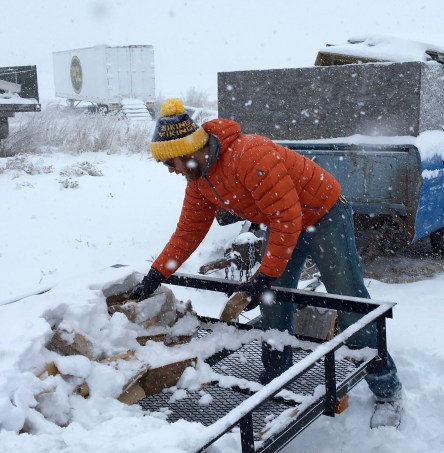
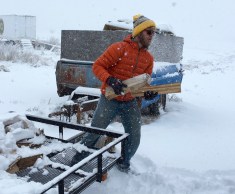



• • •
December 9, 2015
Firewood for the Elders …
All last summer and into the Fall, we have cut wood. Lots of wood. Lots and lots of wood. Not for ourselves. But for our community.
Every group that came to the Rosebud last summer spent time “stumping” – pulling dead trees and stumps out of our hay fields; cutting; and splitting wood. We built four wood bins, then four more, then four more, and then four more after that. We’ve filled more than half of them.
Our goal is to take care of those who don’t have enough firewood to keep warm on our cold nights.
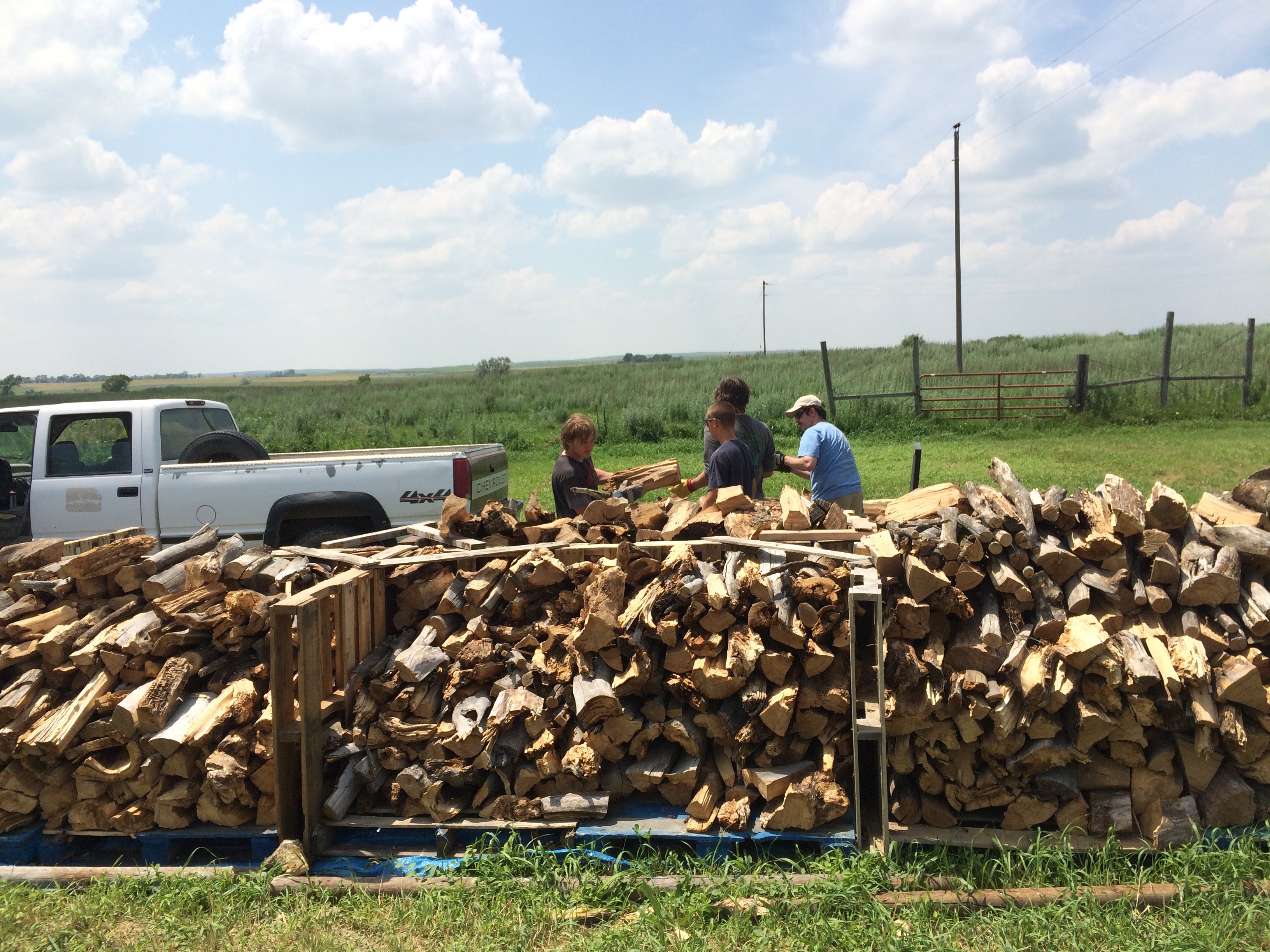 Because keeping people warm is part of how we build up hope on the Rosebud.
Giving it away? For free? That builds up hope even more.
Our program is called Firewood for the Elders.
And we couldn’t have started this program, much less kept it going, without all the volunteers who spent time hauling, cutting, splitting and stack the wood.
To all those who have worked on this program, on behalf of our elders, we say Wopila tanka! Thank you very much, from our hearts and from God.
Grandmother Violet and her grandchildren received a quarter-cord of wood today. Her grandchildren, included the youngest who is still in diapers, worked with Tom Gehring of the Young Adult Intentional Community and Mother Lauren to unload the wood so they could stay warm tonight. Afterward, Tom and Mother Lauren cut down other wood that had been delivered to Violet but was too big for her wood stove.
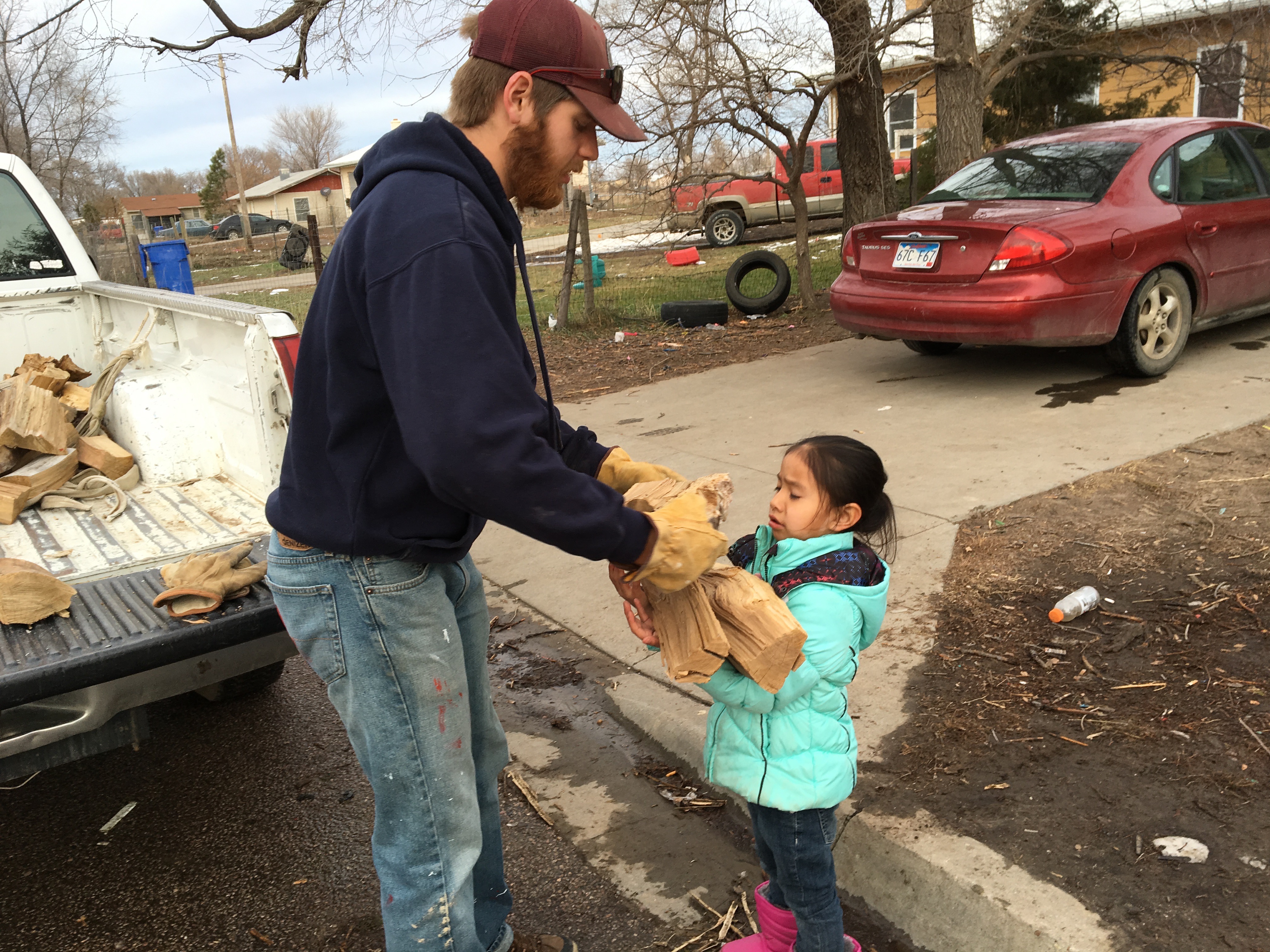
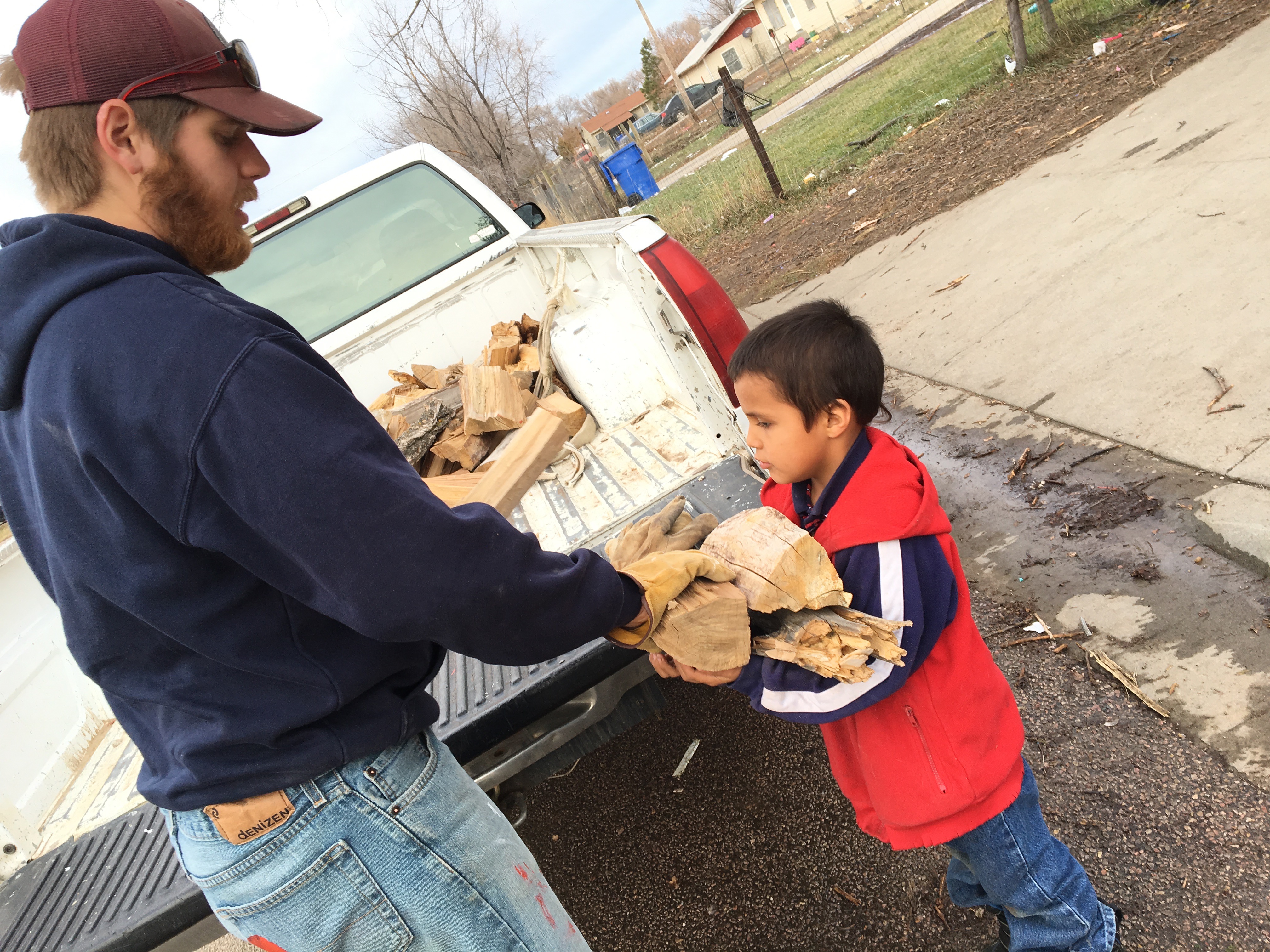
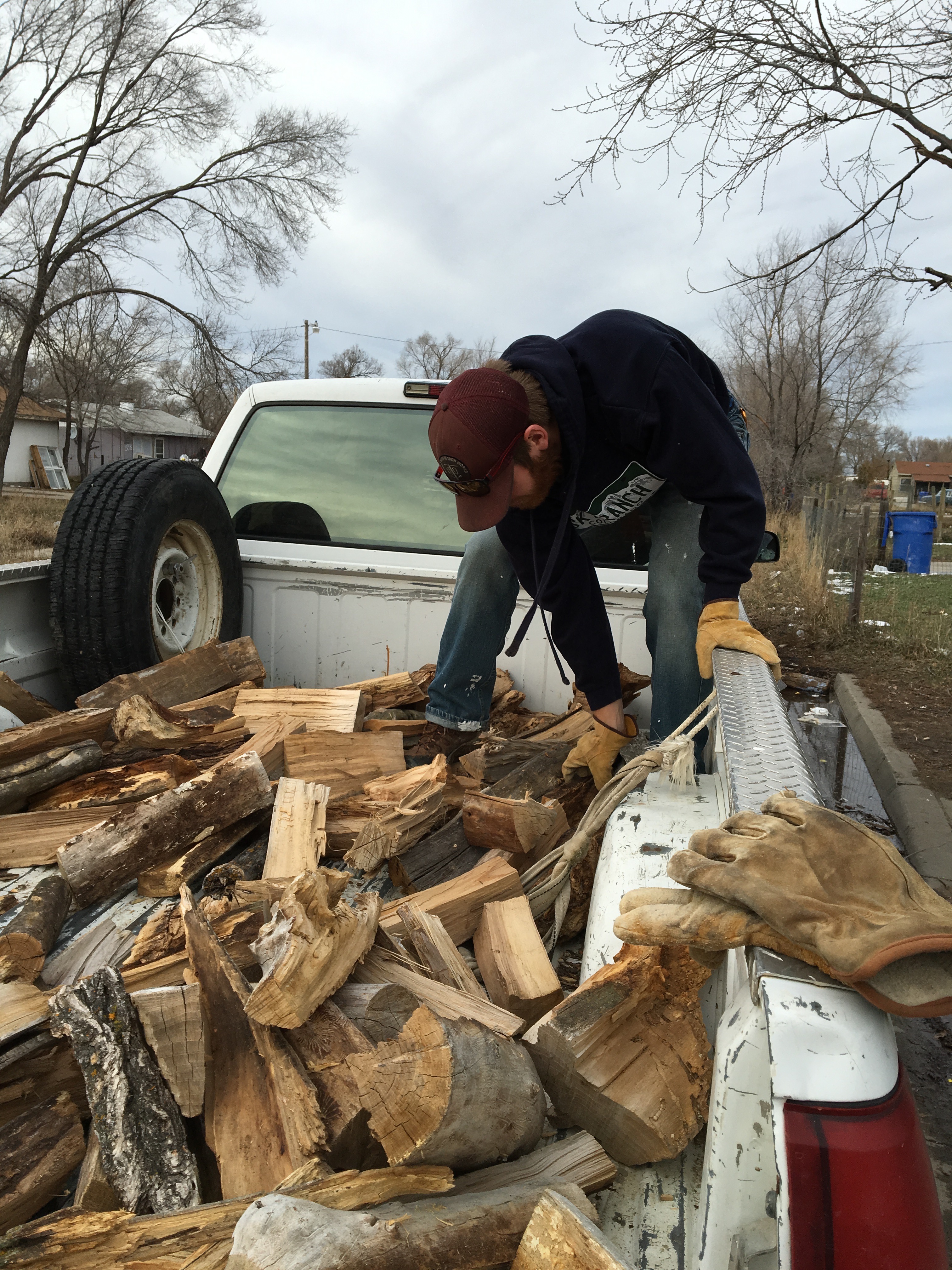
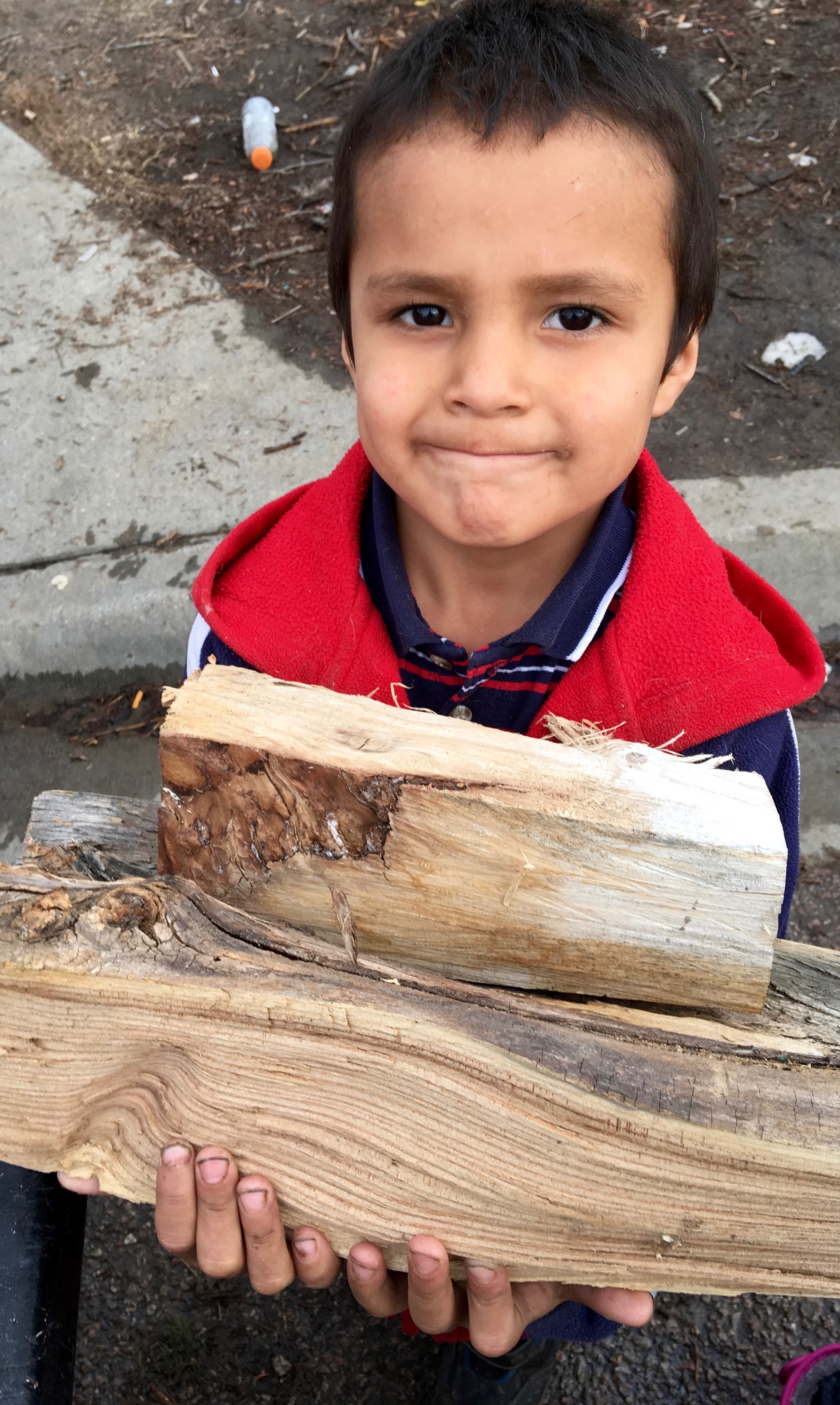
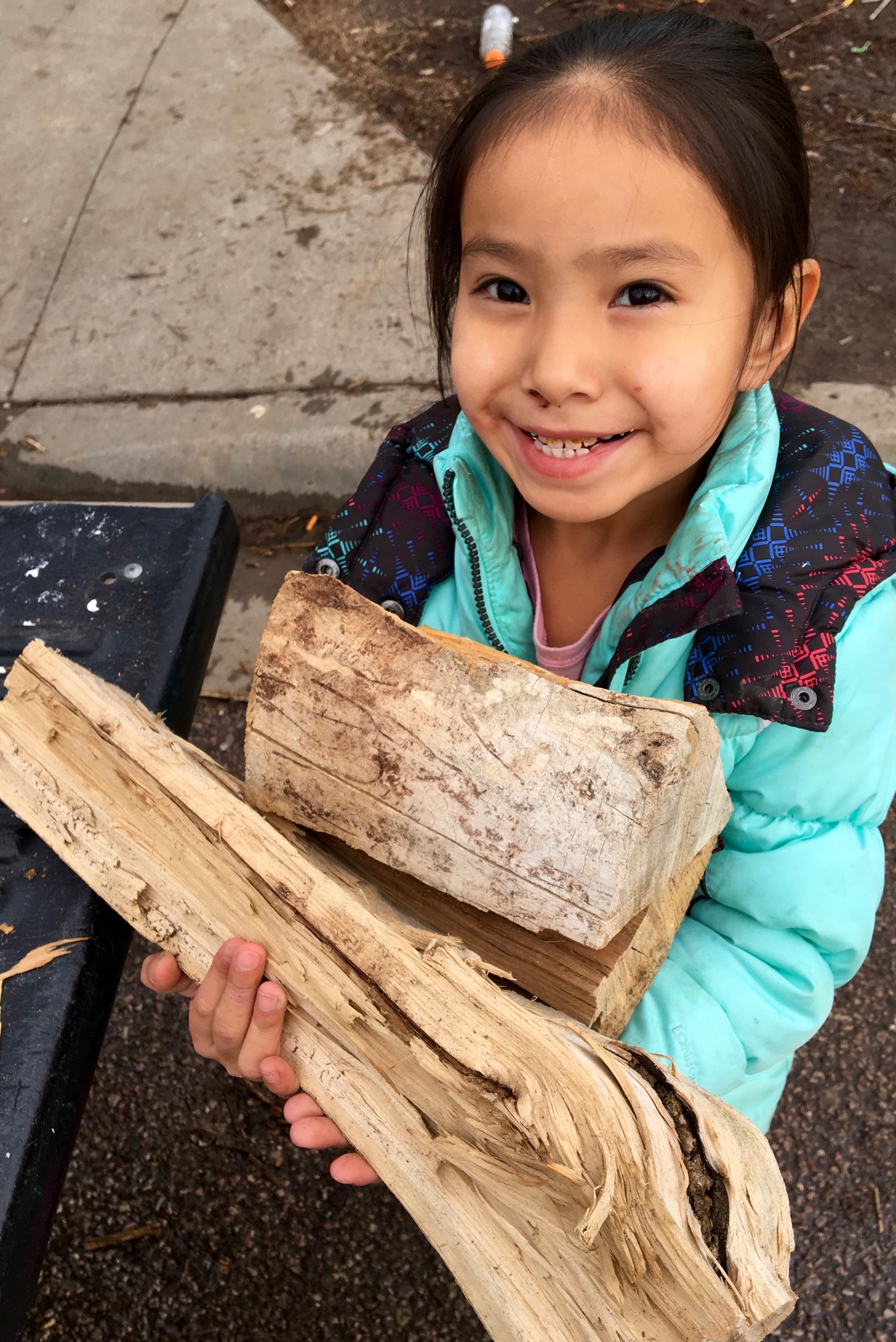
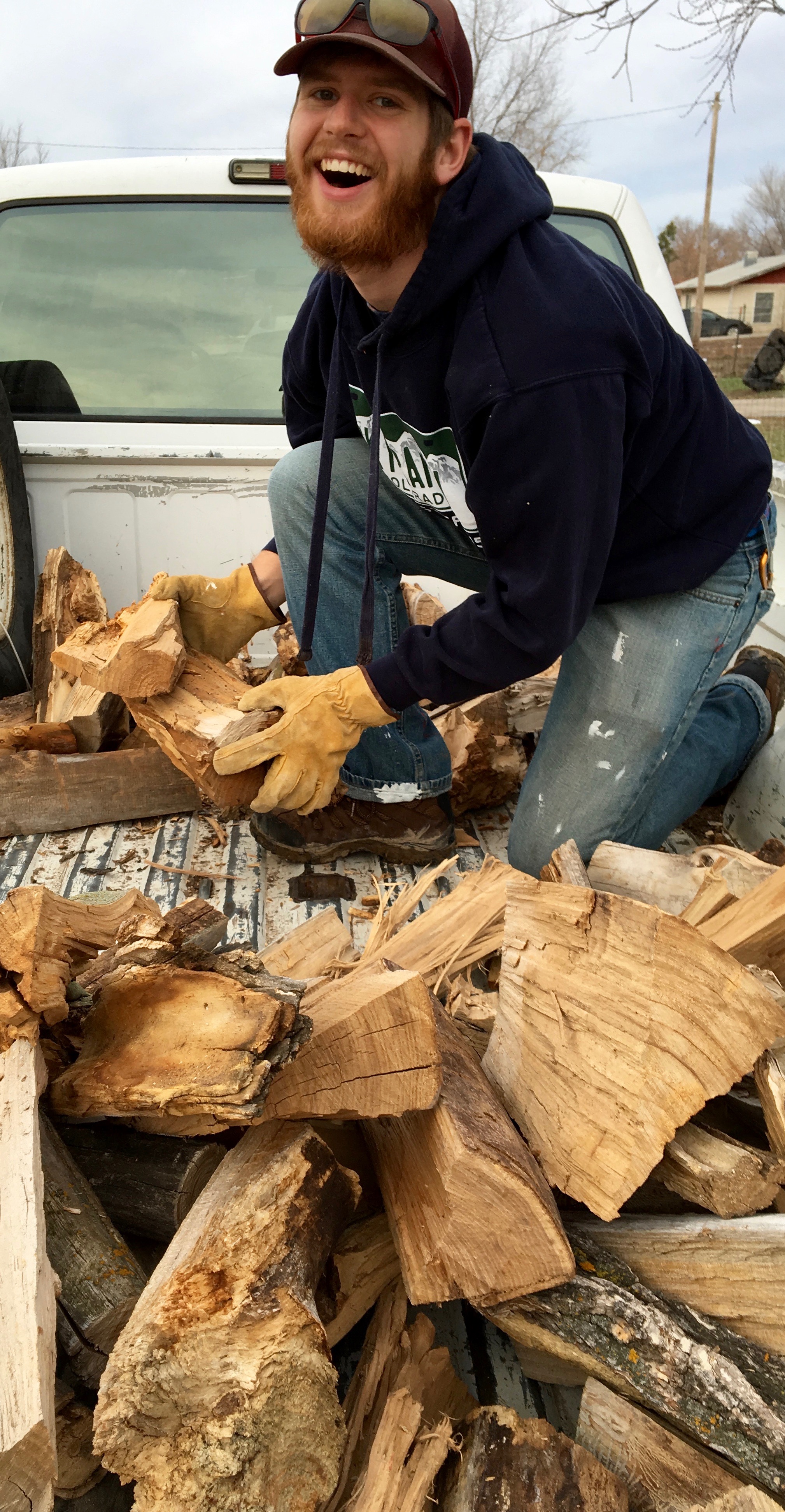
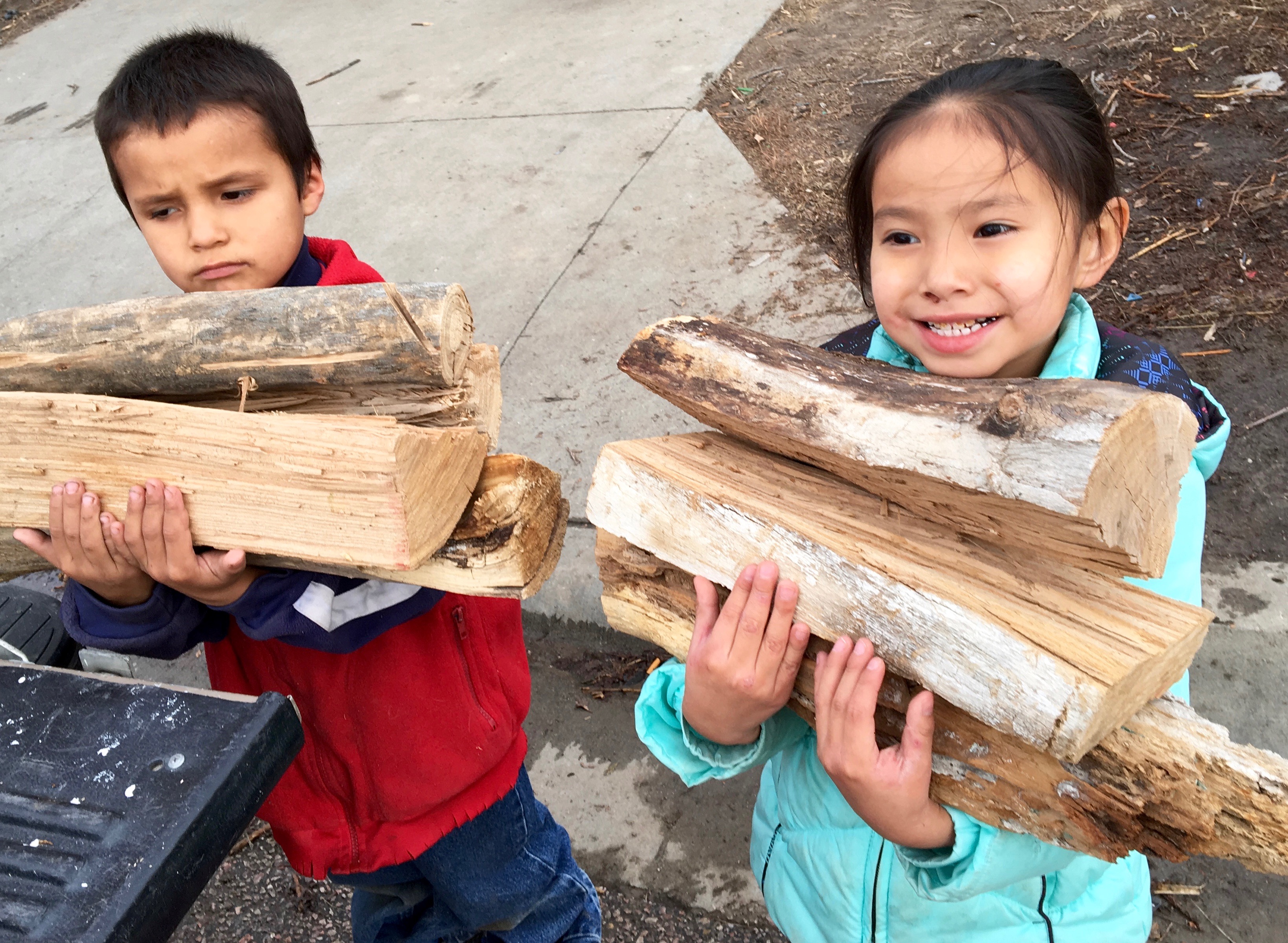
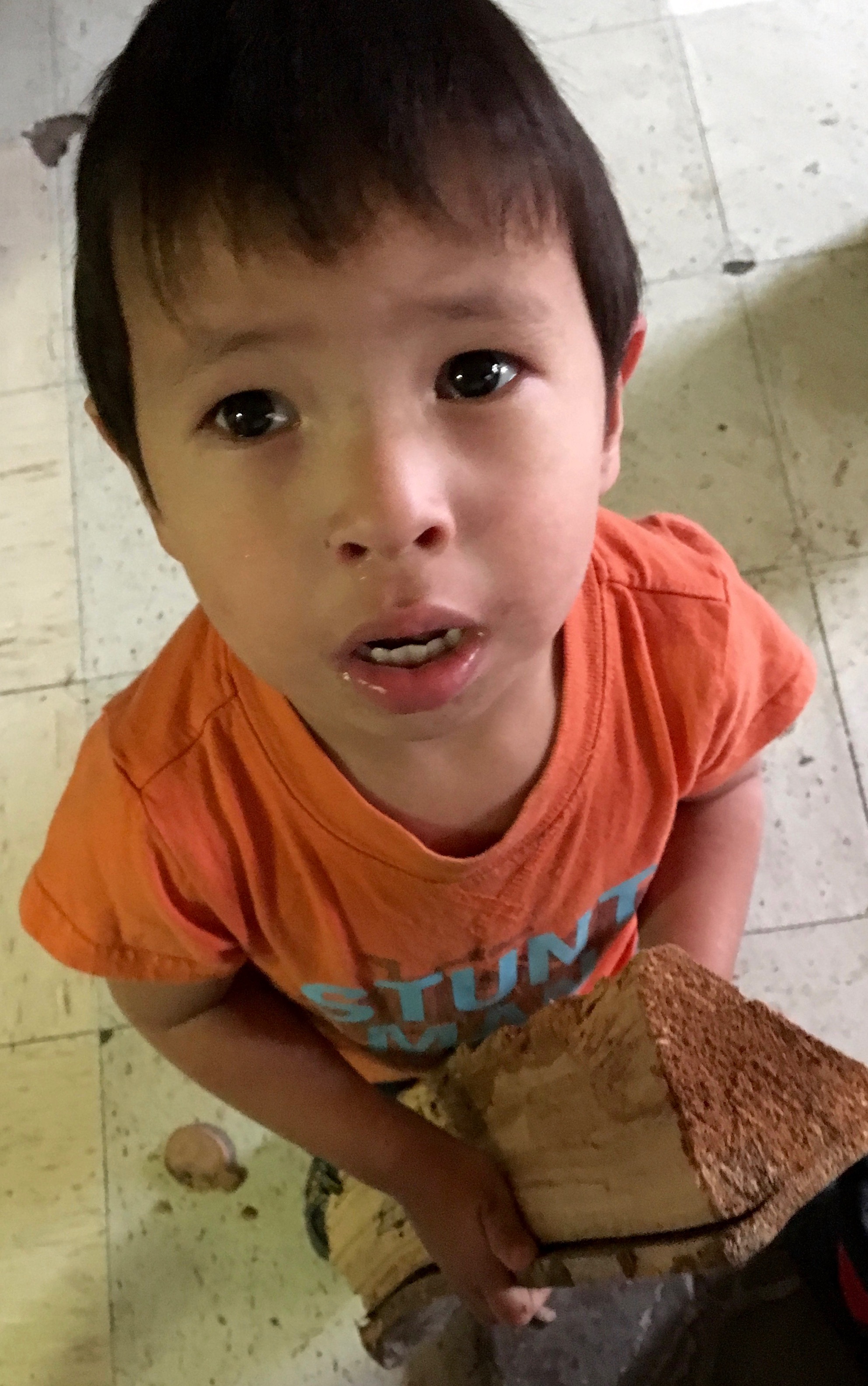
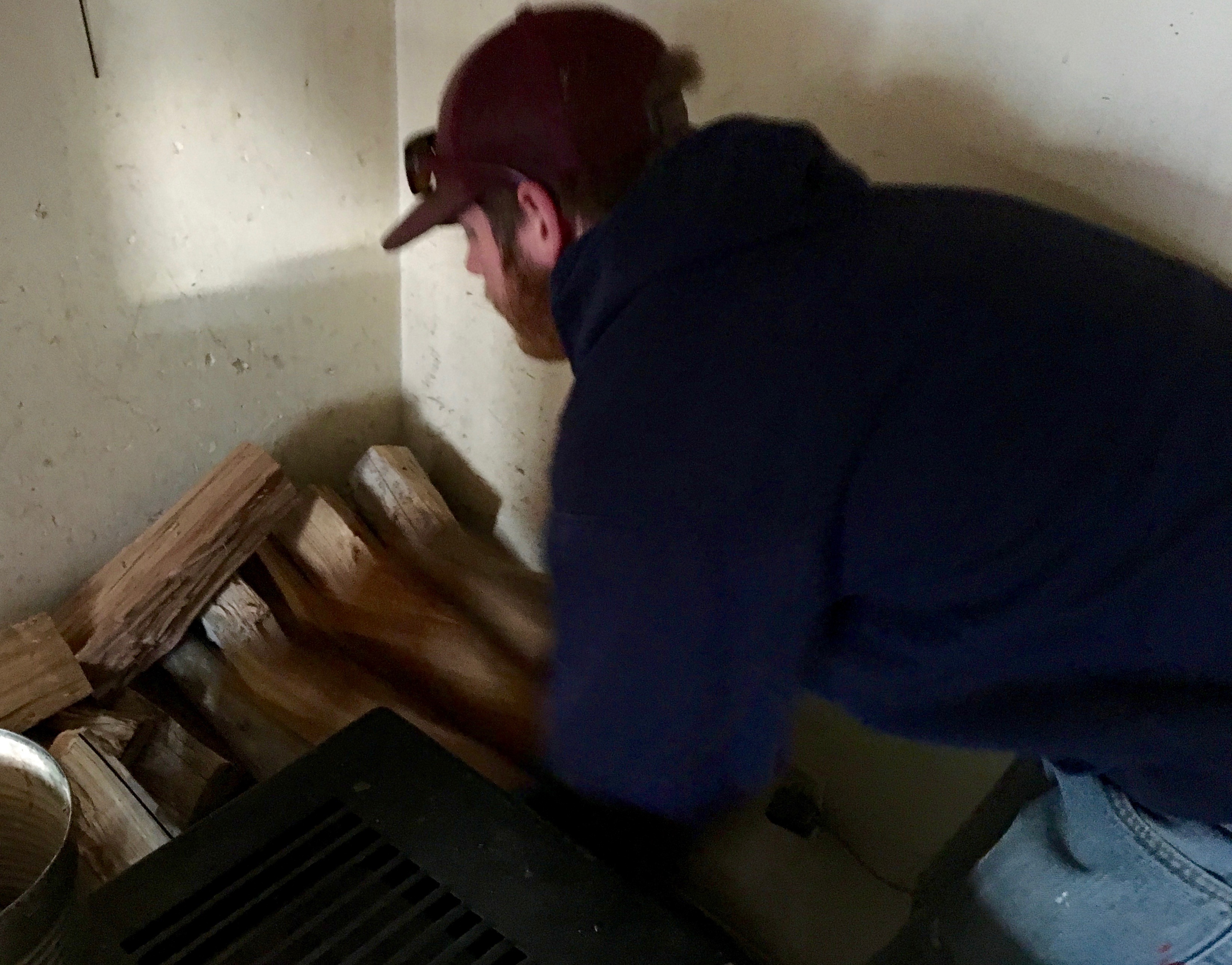
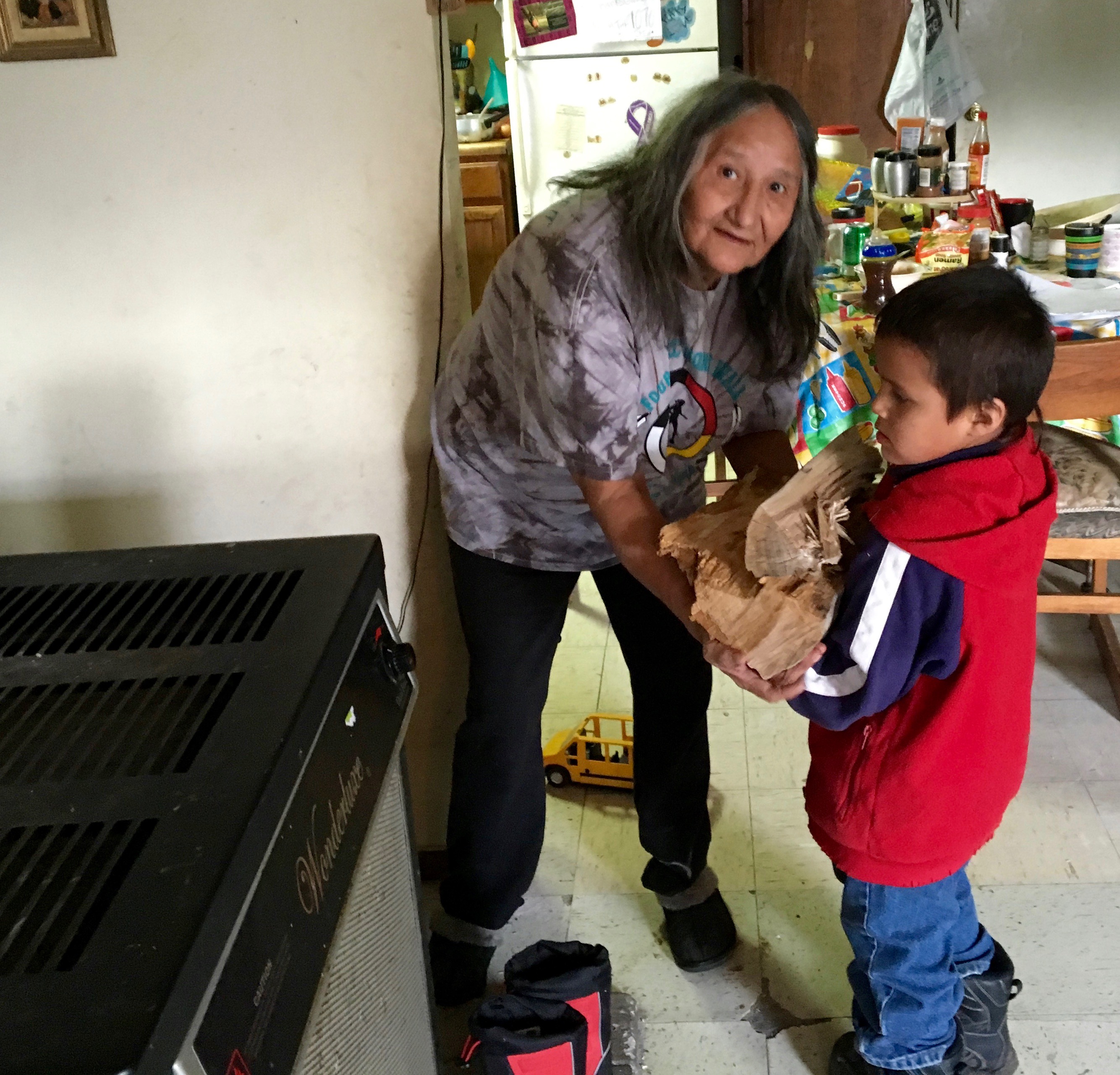
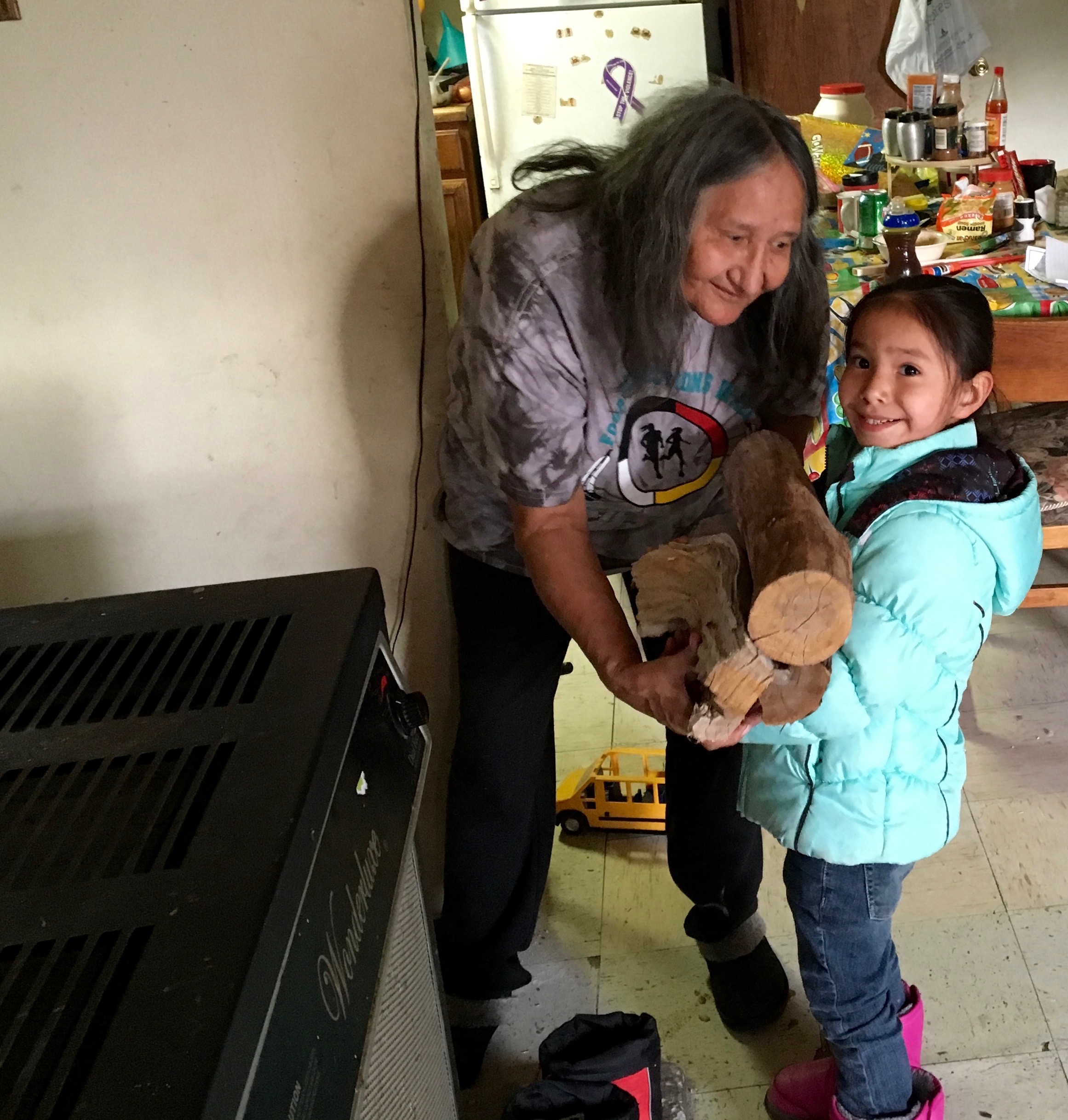
• • •
Here’s a fun fact about me: I have been apprehensive to new situations my entire life, and moving out to the Rosebud was no different. I graduated from Augustana College in the spring of 2015, just in time for me to finally feel settled into the campus community. All of a sudden, I was packing up my things along with the rest of my graduating class to venture forth into the great unknown that is adulthood. Everything that I had to come to know and love as familiar was gone. I knew all of this would eventually happen; I just had not mentally prepared myself for it at all. Suddenly, I was standing on the cusp of the next chapter of my life: a chapter that includes a different culture, different living situation, different daily rhythm, and different day-to-day activities. Apprehensiveness did not truly know itself until it found me in the weeks before I moved to Mission in September!
 However, just two days before I left from home, my dad decided to share this passage from Matthew, which had been the focus text of a conference he had just attended. Jesus’ words comforted me and prepared me to make the final shove into my new life in a new community. The images of staying in a home until leaving and shaking the dust off one’s feet when necessary brought all of my fears and nervousness into clear focus. My purpose and call to live in this place was, for the first time, revealed to me. I am meant to stay here until I leave. My time is temporary, but not inconsequential. My presence is new and unfamiliar, but not without purpose.
In a nutshell, what Jesus commands in Matthew’s Gospel is what I have been doing during my first three months on the Rosebud. I show up to things, I remain as long as I am needed, and then I leave. It is a simple formula, but here’s the kicker: It works. I attended so many community events and church services my first month that I could barely keep all the places and people sorted out in my head. This is understandable considering there are at least five communities named after creeks. So confusing Horse Creek with Corn Creek is, at the very least, somewhat forgivable. The point is, I was overwhelmed and felt like I was sort of a decoration piece. I was introduced many times as one of the new members of the Intentional Community and would share my rehearsed introduction about who I am, where I am from, and what I intend to do during my time on the Rosebud. Those first weeks were tedious and I often felt that I was not gaining any ground in becoming a member of the community. But time went by, and I was proven that those feelings were fickle.
Though it might have seemed like I was not gaining any ground or making lasting connections, I was still doing what Jesus commands his disciples to do in Matthew’s Gospel; I was being present. I offered up myself and people have accepted me for who I am. If I am away from the reservation for a weekend, people let me know that they missed me at church. When I tell people about upcoming events in my life, they make a point to ask me about it and want to hear about my experiences. By simply being present in this place and remaining here, I have been living out my call to ministry. A good weekly reminder of this fact is the GLORY youth program when my youth friends and I always delight in each other’s presence and the joys that a few rousing games of “tag” can bring. I believe now that a large part of the Young Adult Intentional Community’s mission is to show up in the lives of strangers and offer them our lives and our presence for the time we are out here. In other words, we are called to “show up” and “stick around.”
Over the last three months, I have entered new and unexpected places, and I intend to remain in these places up to my final minutes before I leave. More importantly, however, is that my efforts at being present have shed light on the importance of those around me. My presence is meaningless without others to share their presence with me. Because I am in a new situation, I have stumbled, made mistakes, and done my best to adjust. But in the midst of all of these shortcomings, I have been carried, lifted up, and supported by the people with whom I am trying to be present. It is in this sharing of presence that we catch a small glimpse of the Kingdom of God where we are all in right relationship with one another.
December 8, 2015
From Tom Gehring, Young Adult Intentional Community
Over the last three months, I have entered new and unexpected places, and I intend to remain in these places up to my final minutes before I leave. More importantly, however, is that my efforts at being present have shed light on the importance of those around me. My presence is meaningless without others to share their presence with me. Because I am in a new situation, I have stumbled, made mistakes, and done my best to adjust. But in the midst of all of these shortcomings, I have been carried, lifted up, and supported by the people with whom I am trying to be present. It is in this sharing of presence that we catch a small glimpse of the Kingdom of God where we are all in right relationship with one another.
 Rosebud Episcopal Mission
Mother Lauren and crew, u are doing a great job. Need any help anytime. Contact me I will help. God bless
LikeLiked by 1 person
Thanks, Ruth! Let me know AFTER Easter when you might be able to come help!
LikeLike